
One prediction keeps surfacing in go-to-market conversations: autonomous AI agents will replace SDRs within two years. If it is right, founders should stop hiring them now. If it is wrong, the companies that cut will run short of pipeline as competitors add.
At a recent Madrona AMA for our portfolio’s sales leaders, my teammate Eric Wong and I hosted Sam Nelson, founder of SDRLeader.com. Sam was in the first group of SDRs at Outreach in Seattle and later became my top SDR leader. He now runs a community of more than 2,500 companies.
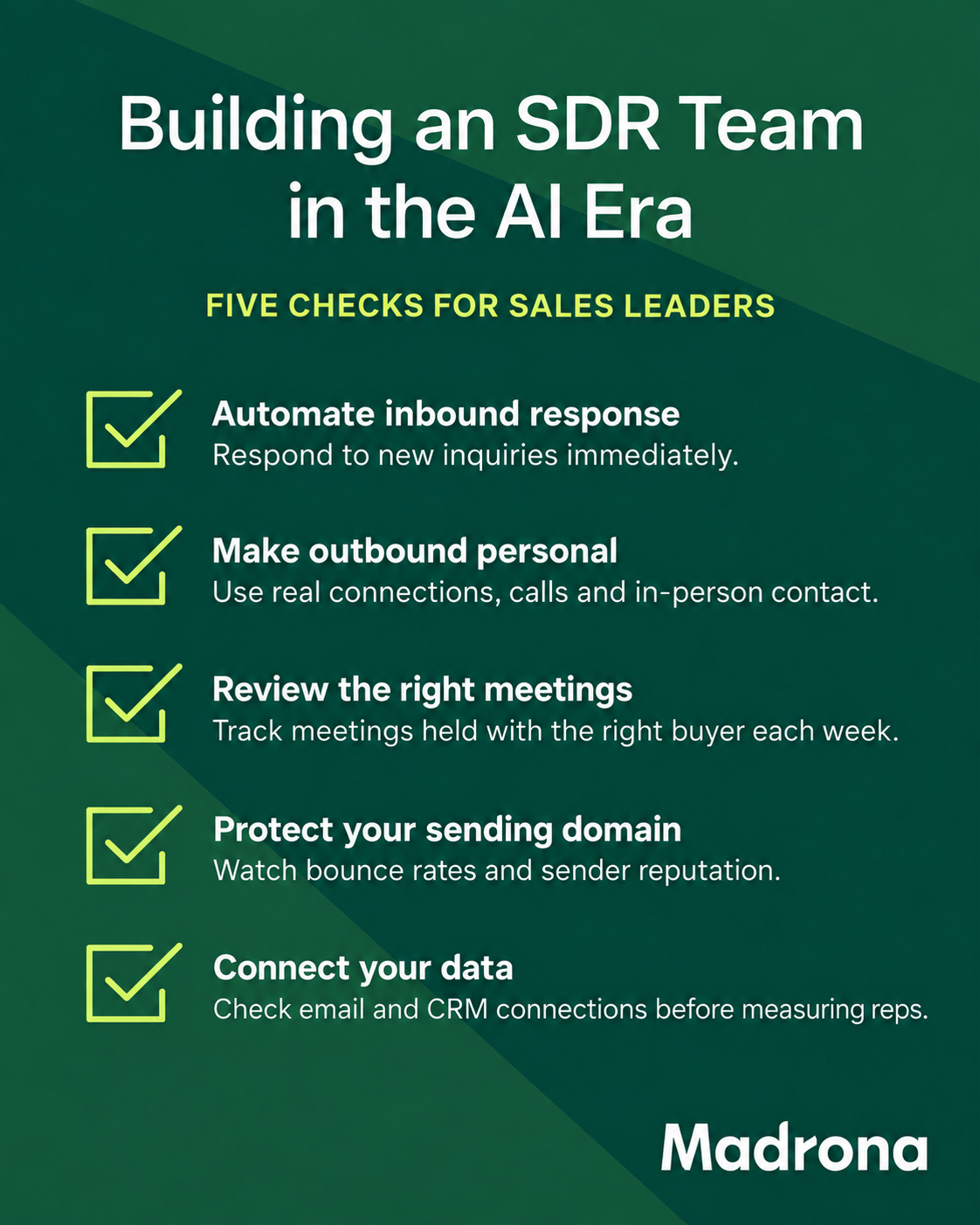
Sam hears from SDR leaders constantly, and what he reports actually points the other way: the companies furthest along in using AI are adding SDRs. This post covers where automation works and where buyers still need a person, the one metric he holds every SDR to, how to spot an AE gaming conversion rates, and a domain risk that can quietly sink an outbound program. If you run a sales team or are about to build one, here are specific changes to make.
Will AI Replace SDRs?
Sam has heard the fear of job cuts before. When he started at Outreach, software promised to automate much of the SDR job. Sales engagement platforms did automate about 90% or more of what SDRs had done before, he said, and then “strangely, the number of SDRs increased really dramatically over time.” By his count, SDR organizations quadrupled in the four years after 2017.
AI is a bigger jump in productivity, but Sam says early signals point the same way. Companies at the edge of the frontier, including the frontier labs, neo-clouds, and infrastructure companies, “have doubled their SDR count over the last year,” and they are adding SDRs faster than the rest of their go-to-market headcount. In his view, headlines about SDR layoffs come from companies struggling to win new business.
Sam and his team also run a benchmarking series, and a key metric we are asked continuously by founders and GTM leaders is AE-to-SDR ratios. The survey Sam published earlier this year noted that AE-to-SDR ratios sit at roughly 3 AEs per SDR and a bit higher in enterprise. The survey also noted approximately 8 SDRs per SDR Manager.
Proof of Human
SDR work is split in two. On inbound, speed to lead matters more than anything else, and Sam expects agents to end up handling all of it. On outbound, the tactics that work carry some proof that a person is behind them, because people respond differently to humans than they do to robots.
“It’s very easy to ignore an email. It’s a little bit awkward to hang up on someone on a cold call,” Sam shared. “It’s even more awkward to walk away from someone in person.”
With AI, personalized email is now commoditized. Warm openers that still work reference a past interaction between the two companies, or a named person at yours who knows someone at theirs. AI can write “I saw on LinkedIn that you do this” for anyone. AI has leveled the playing field on professional-sounding emails.
SDR Leaders Will Absorb Marketing’s Work
Sam predicts that SDR leaders will eventually take on things ordinarily done by marketing, like webinars, brand, and dinners, because they have a clean incentive structure. He actually had the opportunity to do this in his last few years at Outreach. He put SDRs at conference booths, hosted dinners, and tried other efforts that together closed millions in business that were 100% attributable to them.
“Every company’s bottleneck is pipeline,” he said, and the SDR org is the one team where keeping your job depends on incremental pipeline that is 100% attributable to them.
One Metric, Reviewed Weekly
Pipeline takes too long to confirm, so opt for a shorter loop: one goal for the SDR, a meeting held between an AE and the right person, reviewed weekly or monthly. You define who counts as the right person. If those meetings do not turn into pipeline, change the definition.
That definition is a read on your ICP, too. When meetings fail to convert, the team is often talking to the wrong buyer. Sam said a healthy SDR team sees about 80% of booked meetings actually happen. A rate near 100% can mean reps are only working the easiest leads, because anyone reaching hard-to-get buyers will see some no-shows. SDRLeader.com’s study found the median team lands at 80% of booked meetings held, and AEs then accept about 80% of those as real opportunities. New SDRs take about three months to reach full quota.
Outbound Agents and the Domain Risk
Autonomous outbound SDR tools have raised large rounds, yet they rarely come up when SDR leaders compare notes, and a tool that worked at scale would be front-page news. One theory is that the traction is at newer, smaller companies, where these tools are “replacing the very massive and extremely ineffective industry of outsourced SDR shops,” Sam said.
The risk to watch is your domain. Many of these tools amount to marketing automation sent through your own domain, and a new domain is fragile. Mass outreach can get it flagged as spam, and spray and pray raises bounce rates and can get a domain blacklisted, which stops all email. Teams in that spot often blame the copy or the ICP when the sending domain is the real problem.
Leaders at the frontier labs offered two tips for using AI inside a team: connect everything, because results track “the frontier model times the context,” and feed the model your LinkedIn archive, which includes every message you have sent, to help prioritize. Connection matters when you measure people too. I keep seeing leaders conclude a rep is not sending messages when that rep’s email simply is not connected correctly to the CRM. Make sure you have all data sources connected correctly before you use AI to measure productivity.
What This Means for Founders
The only person with a cleaner pipeline incentive than an SDR leader is the founder. AI has made the surface area of what you can do as an individual much, much higher, and many of the tactics above once took an SDR team’s capacity to run. Now, the founder has capacity to do these things too.
That matches what came up at our recent CEO Summit. The companies seeing the most traction have CEOs who post on LinkedIn and share what they are seeing in the market, which gives buyers a path to trust them before a sales conversation starts. Start there and let a weekly count of meetings held with the right buyer tell you whether it is working.