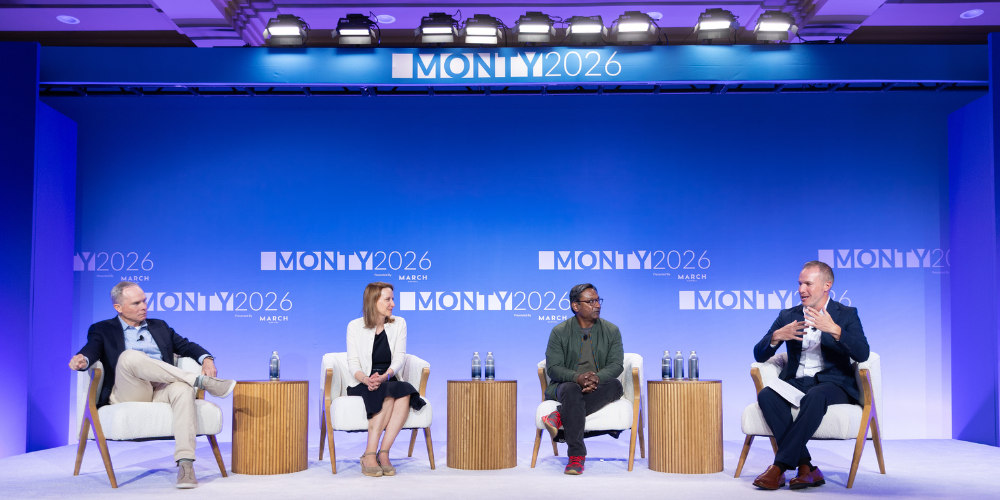
We are at a point in the AI cycle where the gap between interesting companies and enduring ones is becoming visible. The 2026 Montgomery Summit was, above all, a forum for taking that question seriously.
The Summit brought together leaders in tech, finance, and government to chart a path beyond buzzy potential, and toward the delivery of long-term value. Three overarching themes emerged that are worth discussing.
Disruption vs. Durability
I had the opportunity to participate in two sessions with talented leaders in innovation and investing: a discussion with Axiom CEO Carina Hong on applying formal methods to verify AI system outputs, and a panel on the 2026 private capital outlook. The question across both conversations was the same one investors are asking across the market: how does AI’s unprecedented opportunity translate into durable, long-term value in the Reasoning Revolution.
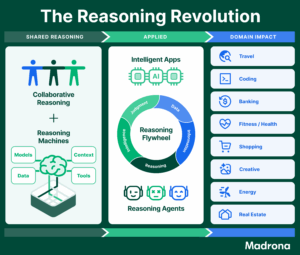
Experimentation remains high and switching costs remain low in many AI solution categories. Models are NOT all you need to capture customer value. Distribution still differentiates market success in ways that pure technical capabilities do not. Several Madrona portfolio companies presented at the Summit (Gradial, Read.ai, Nosis, and Axiom Math) described how they are building reasoning machines (models + context + tools) to deliver value. Overall, the most compelling companies offered more than a product story: a thesis for why they become harder to remove over time. That is the distance between an interesting AI company and a durable one, and a handful of teams are already closing it.
That is the filter we apply at Madrona on every investment, and the Summit reinforced why it matters.
National defense and American dynamism are top of mind.
This year’s Summit gave significantly more attention to national defense, dual-use technology, and American industrial capacity than prior years. That reflects both the geopolitical moment and a genuine recalibration among investors about where mission-critical innovation is being built. The defense technology ecosystem is attracting serious engineering talent and operating at a pace that would have been difficult to imagine five years ago. Whether or not you invest in that category directly, it represents a meaningful and growing portion of where AI capability is being stress-tested in ways that commercial applications cannot replicate.
Domain-specific AI is where the evidence is strongest.
The most substantive conversations I had at the Summit were concentrated in specific domains: life sciences, travel, and enterprise AI “wedges”. In each case, AI is solving problems with enough consequence and specificity that adoption is accelerating beyond the typical enterprise sales cycle. Life sciences in particular appears to be approaching an inflection point (also noted at January’s JPM 2026 Healthcare Conference). The combination of reasoning models and multimodal data are leading to major licensing deal with AI startups. Enterpise wedges in areas like marketing where Gradial leads or browsing tools where BrowserBase excels are showing economic viability that was not present 18 months ago. If the question is how AI delivers tangible impact, these examples offered a clear answer.

Cautious optimism.
The gathering carried genuine excitement about new technologies and their real-world application — made tangible by the caliber of execution on display from many presenting companies. But Summit attendees were also clear-eyed about the stakes: AI is maturing as a technology that can deliver real success or real failure for a user, a startup, or a defense organization. And as a sector, it has defied historical patterns in ways that still require careful navigation, from the speed of capital deployment to the timeline for delivering returns.
None of this plays out in a vacuum. Capital markets are re-pricing risk and longevity – including calling into question the durable value of incumbents! Geopolitical complexity is reshaping where and how technology gets deployed. The companies that will matter a decade from now are being built amid all of this, not despite it.
The world has never felt more complex, but complexity is not the same as pessimism. What I observed — on stage and in the conversations around it — confirmed something I have believed for some time: the fundamentals of building a durable business have not changed. What has changed is the size of the opportunity for those who get it right.