A decade ago, I predicted the rise of intelligent applications. Today, they are ubiquitous. The next decade’s work is harder and matters more: harnessing the capabilities of AI reasoning systems to continuously deliver economic and societal value; the ROI of AI. Getting there will take three harnesses working together: technological, economic, and political. I’d argue this is the defining challenge of the Reasoning Revolution.
Right now, most of us are using a sliver of what these systems can do. Personally, we chat with an agent that retrieves basic information. Inside our companies, AI mostly decorates existing workflows rather than transforming them. As a society, we’re still working out what we’re willing to trust these systems with, and on what terms. That gap — between what AI can already do and what we’ve woven into our lives and institutions — is the story. Closing it responsibly is the work ahead.
The last decade built the components: models, agents, tools. This next decade is about harnessing them.
We’ve already proven that data, compute, and the right math produce reasoning machines that complement human reasoning. At this point, curiosity and creativity (and, for the moment, infrastructure) are the only real limits on what we can discover with them, in science, commerce, and art. But broad diffusion of that capability depends on something else entirely: trusting it, verifying it, and getting a return on it. Here’s how I think about the three harnesses required to get there.
The Technology Harness: A Continuously Improving Flywheel
Today’s models, tools, and agents have more potential than most people’s ability to extract value from them. AI’s current capability is incredibly powerful but a gap remains with context and orchestration. The question that matters is: how do these breakthroughs work together reliably, safely, and affordably enough for people and organizations to discover their full value?
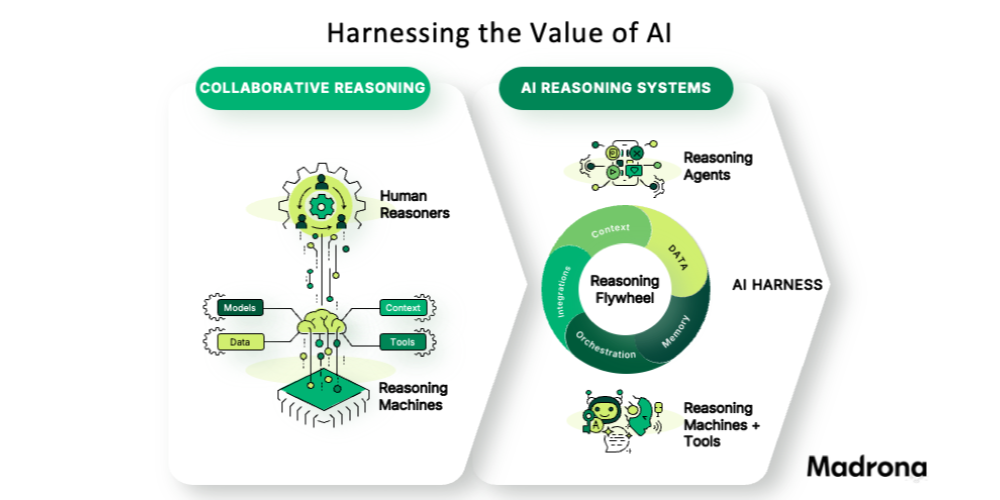
That’s the job of the harness: the layer that stitches memory, orchestration, integrations, and context around models, agents, and tools to produce a specific outcome. Five years ago, at our first Intelligent Applications Summit, we called this the “middle layer” and predicted it would matter. It turned out to be less a layer and more a flywheel: spinning the other components faster, cheaper, and more accurately around a task.
Builders converged on the harness for a practical reason: a frontier model is astonishing and unreliable in roughly equal measure. The harness is what turns “astonishing” into “dependable.” There’s a school of thought — call them the frontier-model maximalists — who believe most of this gets subsumed into the model over time. That’s not how systems are being built or bought today. Frontier capability will keep advancing, but builders and their customers want choice and control across the model, the tools, the data, and the harness. Nobody wants a single point of dependency on a single lab.
Think of the harness as the operating system for reasoning. A classical OS allocates fixed hardware resources to whatever application asks for them. An AI harness does something more dynamic: it selects, task by task, exactly which model, tool, data source, and piece of context an agent needs, and then carries forward what worked into the next task.
The most important thing the harness does isn’t technical at all. It’s where humans and AI learn about each other. It accumulates our context, our preferences, our standards; and it’s where we discover, one task at a time, what these systems can be trusted with. That’s the difference between a transaction and a partnership: a partnership compounds like a flywheel.
You can already see that compounding among early adopters. AI-native people are assembling a kind of digital twin of themselves (their data, messages, calendar, context) so an agent can act on their behalf. The results are simultaneously mundane and remarkable: a system that remembers the college friend you haven’t spoken to in years, surfaces what’s happened in their life since, and drafts the note you’ve been meaning to send. People end up better connected, better informed, and quicker to follow through; not because the model got smarter, but because the harness got to know them.
Enterprises are on the same path, a step behind. Most started with point solutions and are now running into the ceiling of intelligence bolted onto an old process. The next step is systems of execution that carry an entire workflow across data types and departments, which means redesigning the work itself around what reasoning machines can now actually do. Increasingly, that work happens agent-to-agent: yours negotiating with someone else’s, each carrying its own context, reaching outcomes neither could reach alone, on decisions as small as a purchase and as consequential as a hire. What makes delegation at that depth approachable is that the harness doubles as the control surface. It’s where you decide when the agent acts, when you step in, and when a human needs to be in the loop.
This is where the next decade’s compounding comes from. Models are reasoning engines; what we’re building around them are reasoning systems that improve continuously, through use. Every interaction with an agent generates data about how people and companies actually work with AI. Reinforcement learning (and the techniques growing up around it) turns that exhaust into systematic improvement. A better harness makes smarter selections among the models, tools, and sub-agents around it, and that performance data flows back into training the models themselves. Each part of the flywheel makes the others better, faster; continuous improvement stacked on continuous improvement.
The Economic Harness: The ROI of AI
Harnessing AI technically isn’t enough. It has to generate a return, on both sides of the transaction. As I’ve said elsewhere: the most important AI model is the business model.
We’re investing hundreds of billions of dollars a year into the AI stack, and living through a period of genuine reasoning abundance: abundant infrastructure, abundant insight, abundant agentic services, priced by the token, the model call, and more. The question underneath all of it is whether reasoning can be productized by suppliers and consumed by buyers in a way that generates sustainable returns for both. More simply: what’s the ROI on AI?
Pricing is how you harness the value of any product. Suppliers create value through upfront investment and cost of goods sold, then capture it by pricing to willingness-to-pay in a way that produces positive unit economics and lifetime value. If operating costs stay below cumulative gross profit, you have a sustainable business. None of that has changed. What’s different in AI is that the upfront cost to build the system — including data — is often steep; the model, token, and tool mix has to be continuously optimized just to make “reasoning” affordable; customer durability is genuinely uncertain in a fast-moving market, which makes LTV a moving target; and sustaining differentiation requires ongoing human and agentic engagement, not a one-time build.
There’s a lot to unpack across horizontal capabilities (agentic search, browsing, data extraction, context management) but the clearest way to see AI economics at work is in a vertical system of execution: an AI system built to run a specific function or domain end to end.
Think Cursor and Cognition in coding, Sierra and Decagon in customer service, Harvey and Legora in legal, Gradial and Writer in marketing. Each typically has two agentic interfaces (one for the end user, one for configuring the agent) and each leans on a technology harness to connect those interfaces to context, models, and tools, producing an output: code written, a support ticket resolved, a marketing asset updated.
These companies are converging on a hybrid consumption model priced to output or outcome. A lower-cost annual platform fee covers the base subscription; on top of it sits an upfront commitment to a volume of usage, tied to outcomes, outputs, or token consumption. Underneath, the vendor is optimizing the cost of producing a reliable reasoning output; the buyer is weighing the cost, quality, and reliability of an agent-led solution against a human-led one for the same work.
Legora’s newly launched Agent Pro is a clean example. It layers consumption pricing on top of a seat-based platform, unlocking access to more powerful frontier models and a purpose-built harness that plans, executes, reviews, and delivers complex legal work. The billing unit is a “run,” with a dashboard to monitor consumption and governance controls to manage it. It’s a pricing model built for exactly this moment: an upfront commitment paired with a premium tier that matches deeper reasoning and tighter controls to better legal output.
For enterprise buyers, the payoff shows up as hard ROI and softer, harder-to-measure benefits alike. These systems build the muscle for cross-functional teams to trust agents with real actions, and customers who lean in early are on their own compounding learning curve. But the spend must be justified on its own terms — and that justification comes down to one question: what quantifiable output are you getting for the agentic input you’re paying for?
The Government Harness: Healthy Boundaries to Sustain Innovation
There’s a third harness, and it’s getting more attention by the month: balancing model capability against societal risk. Those risks take different forms (model inaccuracy, technical security, personal safety, societal harm) and each requires its own guardrails and governance. The question underneath: who’s responsible for keeping each of those risks in bounds? Or, put differently: who holds agency in the age of agents?
Agency can sit at the individual level, the corporate level, the model or AI-system creator’s level, the government’s level, or societal. My own instinct runs toward personal and local responsibility. But there are moments when government guardrails are simply necessary.
The recent dynamic between Anthropic and the U.S. government is instructive. Anthropic had spent thousands of hours red-teaming its Fable 5 model before launch, working with the government, the UK’s AI Safety Institute, and outside researchers. Days after Fable 5 and Mythos 5 launched publicly in June 2026, Amazon researchers reported a technique for bypassing Fable 5’s safeguards. The government cited it, invoked national security authorities, and ordered Anthropic to cut off access for any foreign national. Anthropic suspended both models globally rather than risk a violation and then worked with vetted U.S. organizations before the Commerce Department lifted the controls.
Whatever you make of the underlying jailbreak dispute, the episode is a preview of how this will keep playing out: a fast-moving, fact-specific negotiation between model providers, their customers, and the government, with real commercial disruption in the balance. It’s also worth watching for a different reason: the risk that the largest AI companies use this dynamic to lock in early advantage through regulatory capture, rather than genuine safety improvement.
There’s a broader societal unease running alongside all of this: specific anxiety about job loss, personal security, and harder-to-name harms, amplified by what we’ve already watched social media do to mental health and attention. Some will argue personal responsibility and “agency” should be the first and most important line of defense. Others will push for faster, stronger rules with real government oversight. Both instincts must be considered, and the tension between them isn’t going away.
In conclusion
There’s far more to unpack about the opportunities, the risks, and the interplay among these three harnesses. But the shape of the next decade is already visible. The technology harness is the layer that turns reasoning machines/models into AI systems that gets better every time they are used. The economic harness is what forces every provider and every buyer — enterprise or individual — to answer the same question: what’s the return on my AI spend? And the government harness is what will force all of us to finally answer who’s accountable when the actions are no longer only human.
Harnessing the value of applied AI isn’t a technical problem or an economic problem or a policy problem. It’s all three, at once, and getting it aligned to benefit society is the work ahead.
Related Insights