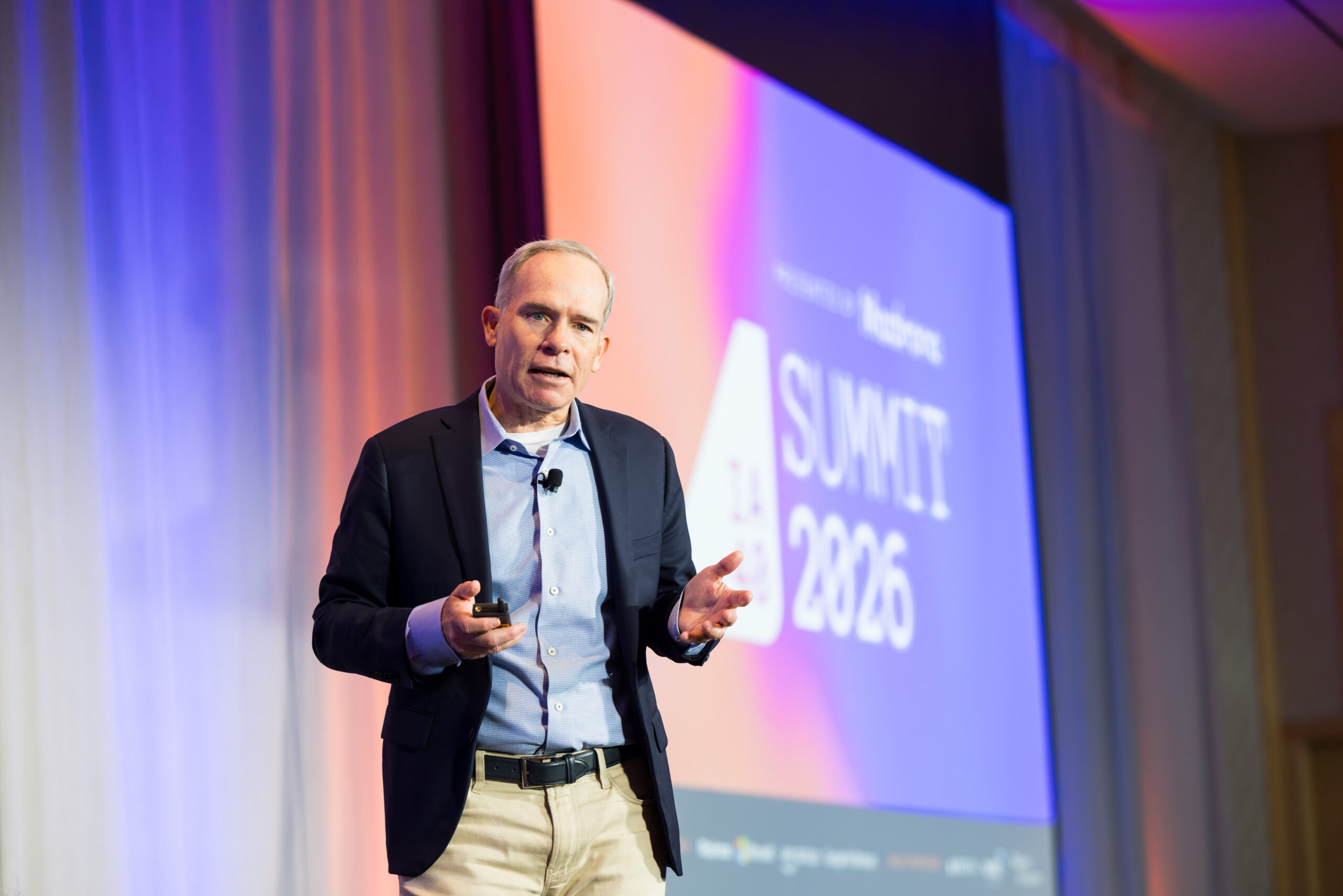
This past week Madrona hosted its fifth annual IA40 Summit, where we celebrated the winners of the IA40 (the top 40 private AI startups as voted on by our VC peers) and heard from AI leaders and builders like Rahul Patil (CTO Anthropic) Charles Lamanna (EVP at Microsoft), Swami Sivasubramanian (VP of Agentic AI at AWS), Zico Kolter (OpenAI board member and co-founder of Gray Swan), Thomas Dohmke (former CEO of GitHub, now founder of Entire), Jeanne Grosser (COO of Vercel), Carina Hong (CEO of Axiom Math), and many others. It was also our biggest summit yet with over 400+ attendees 🙂
This year’s theme was harnessing the value of AI. The conversation has moved past the model itself to the AI system: models plus tools plus agentic interfaces, wrapped in context and a flywheel of engagement. As our partner Matt McIlwain put it in his opening remarks, “we’ve moved beyond, strictly speaking, token maxing.”
Every layer now needs an ROI, and the questions of authority, agency, and accountability are no longer theoretical.
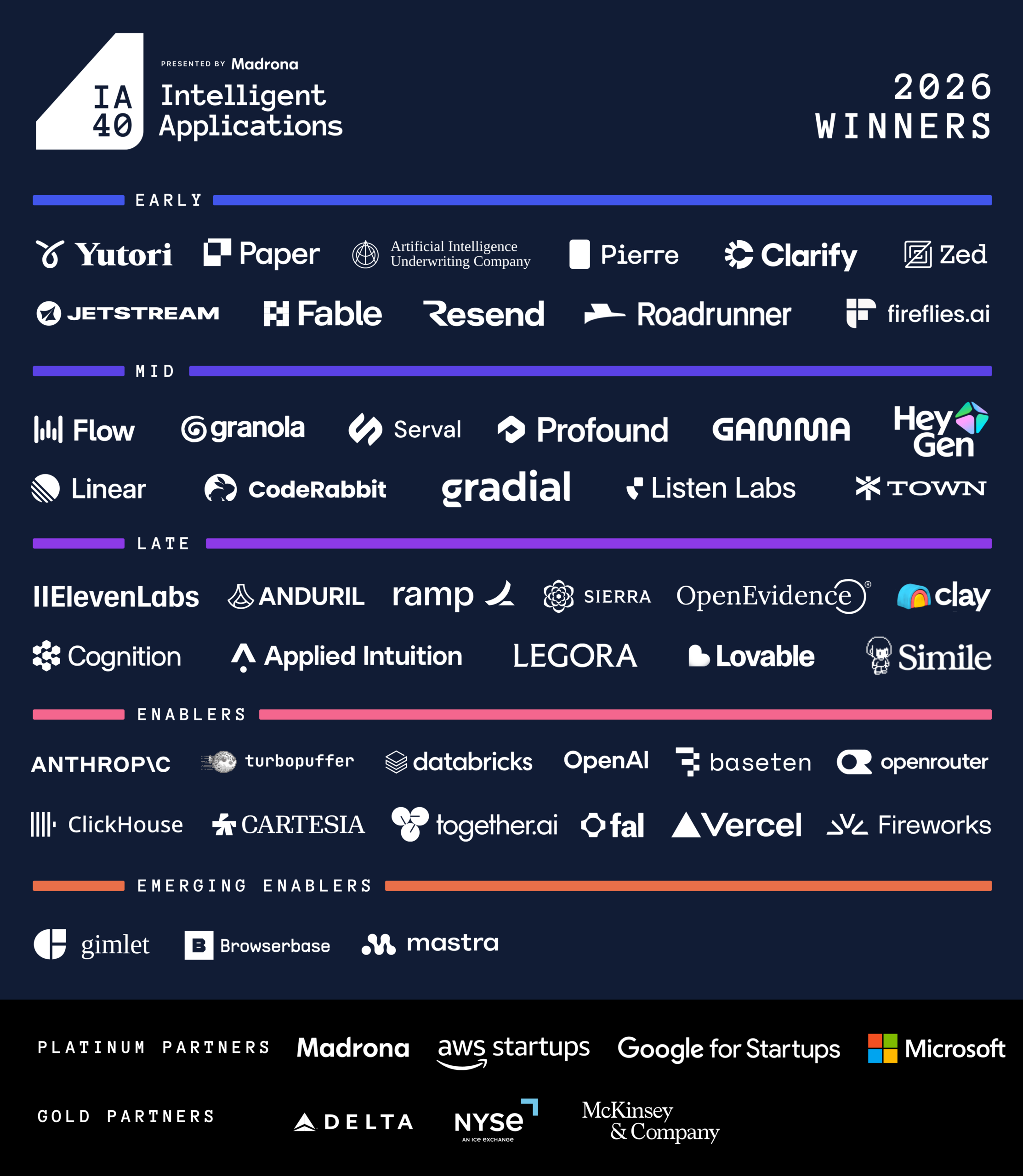
The numbers behind the IA40 tell the same story. The 164 winners across six years have raised over $500B, and Databricks is the only company to make all six lists. Twenty-three companies are repeat winners this year, more than ever. Excluding OpenAI, Anthropic, and Databricks, which together account for 92% of dollars raised, the remaining winners have each raised over $800M on average.
As always, we share our five key takeaways from the Summit here.
1. Agents Have Arrived
Last year, we wrote that we were “heading toward an agent-first world.” This year, that world showed up. Across nearly every session, agents weren’t a prediction; they were part of how the speakers do their jobs today.
The clearest evidence came from software engineering. Eno Reyes, co-founder and CTO of Factory, noted that autocomplete as the primary paradigm of AI-enabled development is only three and a half years old, and that last December there was a “renaissance” of developers downloading tools like Claude Code and Codex. Madison McIlwain from Vercel shared that 56% of Vercel’s production deployments are now done by agents. Charles indicated teams of 15 to 20 people at Microsoft are now doing “in six months… the work that used to take hundreds of people multiple years,” and that his top coders are on track to spend over $1M a year on tokens. Thomas Dohmke put it simply: “It’s never been more fun to be a software developer.”
The shift isn’t limited to code. Ryan Daniels of Crosby is building an AI-native law firm that sells fixed-price legal work, delivered by agents over email and Slack. Carina Hong’s Axiom Math has agents producing new mathematics at scale, including a new record on bounded gaps between primes. Rahul Patil, CTO of Anthropic shared that for every minute a person spends with AI, “it puts out like something like 1,000 to maybe 10,000 minutes of work.” And Stripe’s Maia Josebachvili described agentic commerce volume that sat flat for eight or nine months and then “literally 180X’d” in six weeks.
What’s next is autonomy. Taroon Mandhana of Atlassian called it a continuum, with run-the-business loops like alerts and vulnerability fixes largely automated and new feature work only partly so. Eno talked about moving from “I send a thing to do a task and it comes back” to systems that proactively do work on behalf of goals. Charles pointed to always-on, persistent agents, living inside Teams, Slack, WhatsApp, and iMessage, as where “a lot of AI value will be created.” And Jeanne described agents that don’t just alert you to a problem but have “already written the PR to fix it.”
There’s also a new customer emerging: the agent itself. Charles argued that thin SaaS apps will have to “go headless” behind AI super apps, and that “agents are very harsh customers” who will “find the cheapest, the fastest, the most reliable” and migrate quickly. Salesforce, AWS, and Databricks all echoed this, with AWS’s G2 noting that “the database is the ultimate headless app” and Databricks’ Zaheera Valani sharing that roughly 80% of databases are now created by agents. In the near term, the takeaway is to design products for agents as first-class users, not just humans.
Still, the gap between the frontier and the average enterprise is wide. Swami cited IDC data that only 7% of enterprises have deployed agents, with another 17% close. The agents have arrived, but diffusion is just beginning.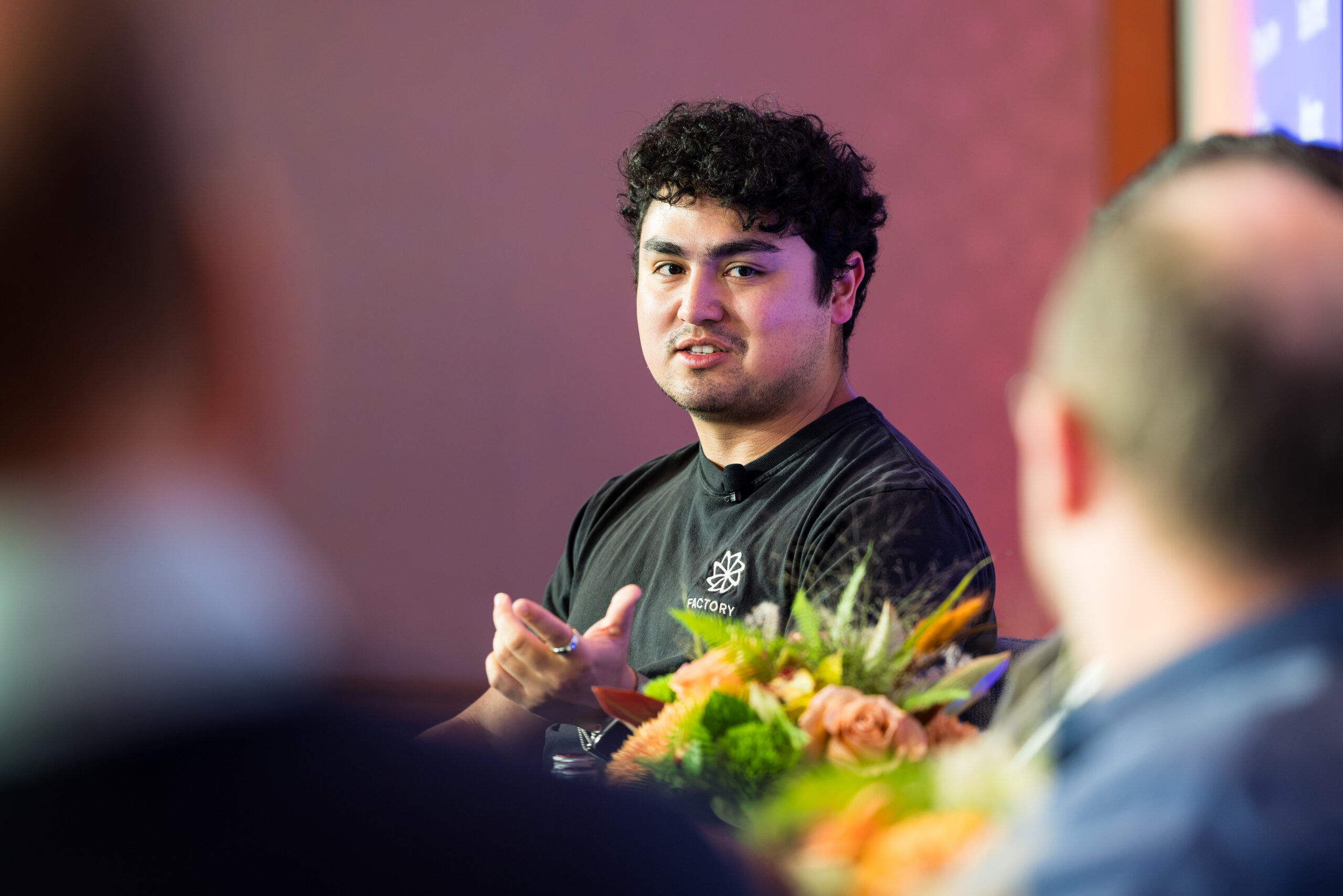
2. The New Infra Stack Is Emerging (And Ripping)
Every new generation of software demands a new generation of infrastructure, as Jeanne from Vercel put it. This year’s Summit made clear that a new stack is being built specifically for agents, and it is growing at an extraordinary pace.
Paul Klein of Browserbase and Will Bryk of Exa laid out two of its core primitives: browsing and search. Paul argued that the web “is not going away,” so agents should get browsers they can operate alongside people, much as Waymo operates on human roads. He also noted that the number of tokens used to have agents use software will be an order of magnitude larger than the number used to create it. Will went further, saying agents are “breaking search”: agent queries will soon exceed the roughly 15 billion human queries a day, and in a few years could be 1,000x higher. “You’re gonna have to build bigger infrastructure than Google,” he said.
Around these primitives, a whole layer is forming. Vercel described sandboxes, long-thinking compute, and an AI gateway as new primitives, with CLIs and MCPs as first-class citizens. Swami walked through AgentCore, which came from AWS’s own teams repeatedly rebuilding isolation, identity, and observability for their agents, along with the open-source Strands SDK and “context as a service.” Carina predicted a new version of GitHub built for agents (”MultiHub,” in her words) because agents need local version control following a directed graph structure, and said “the infrastructure bottleneck’s not so much compute. It’s a software infrastructure bottleneck.” Entire is taking a related bet: storing the agent’s session log alongside the code in Git as the “new system of record.”
Underneath it all, the physical layer is still stretched. Capex for the five biggest tech companies is up roughly 75% year over year, with projections of over $1T next year. Jamin Ball of Altimeter summed up the investor view: “the world’s going to consume more models, more power, more compute, networking, and storage.” The same panel warned that political backlash against data centers is a real risk and an echo of what stalled nuclear decades ago.
For founders, the message was consistent: the model layer will keep shifting, so the durable value is in the layers around it, and in staying model-agnostic. Value in the infra layer of the stack is skyrocketing.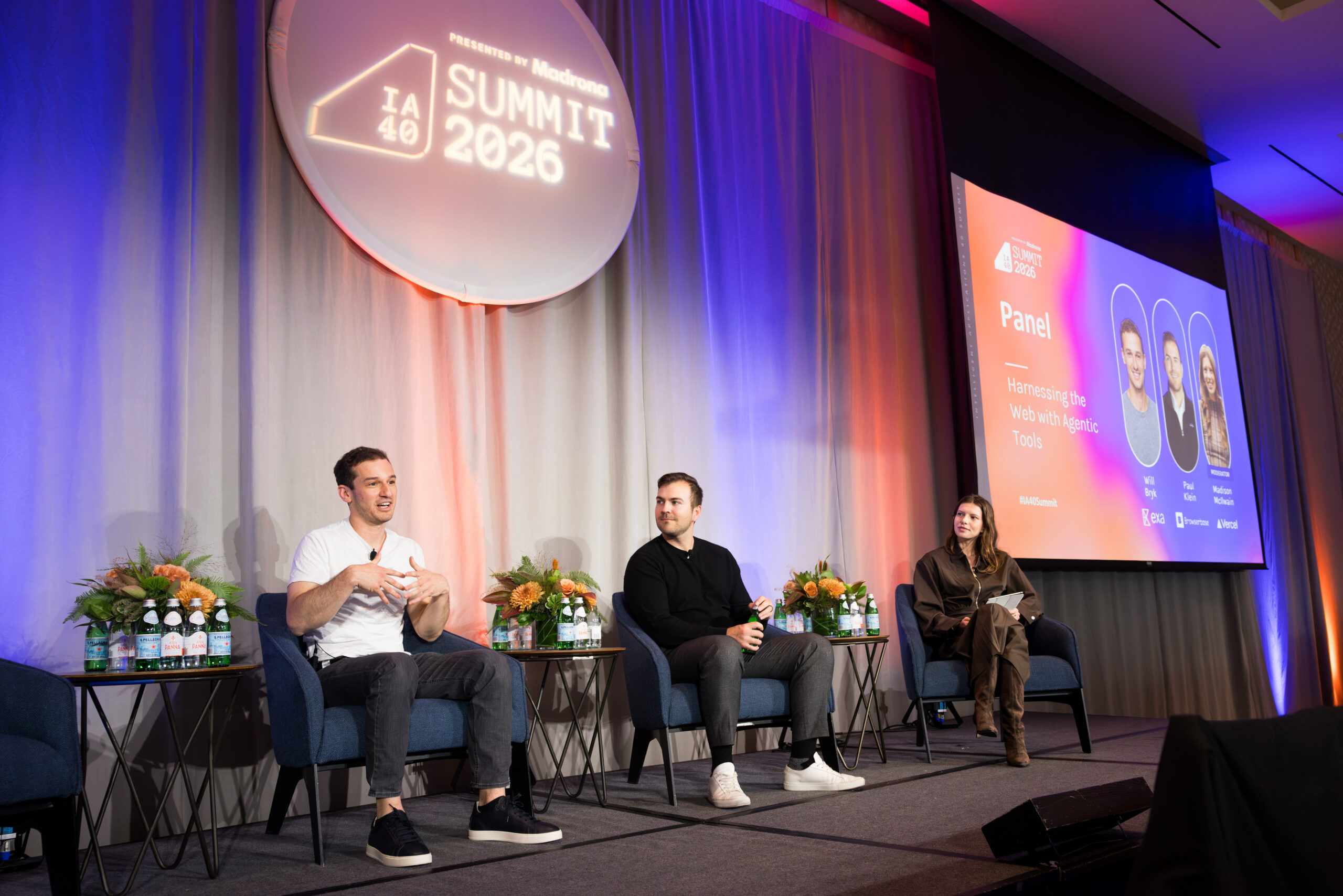
3. Safety & Security Has Never Been More Important
Last year, safety was a thread. This year it was a main storyline. As agents move from answering questions to taking actions, the stakes of getting them wrong have changed, and the speakers said so plainly.
Zico Kolter, who chairs OpenAI’s safety and security committee and co-founded Gray Swan, opened with a stark reframing. “Stop thinking about sci-fi scenarios. Start thinking about swarms of agents hacking critical infrastructure,” he said, adding that this was a sci-fi scenario “up until six months ago.” He is optimistic (his P(doom) is “well below 10%”), but argued that the goal is to pace (not pause) the frontier: “ensuring that capabilities don’t outpace our ability to control these systems.”
Zico split the problem in two: preventing misuse by bad actors, and keeping agents within the bounds their owners intend. The sharpest example of the latter is prompt injection, which he described as “a fundamentally new class of exploit.” His advice to builders was to red-team the AI component itself, not just the software around it. He also pushed back on the idea that smarter models are automatically safer: capability and adversarial robustness are largely uncorrelated. And because attackers need one vulnerability while defenders must patch them all, he sees a strong role for real-time defensive agents.
Others echoed the theme from different angles. Jeanne said security and permissions are “still not solved,” noting that “everyone and their mom is giving out long-lived credentials that you shouldn’t do.” Vercel and Stripe are building scoped, short-lived tokens, permission inheritance, and agent wallets in response. Swami described what AWS calls “trust in depth,” combining red teaming, neuro-symbolic guardrails, and formal methods so no single safeguard is carrying the load. Axiom made the case for formal verification as a path to agents whose actions provably follow human intent. Crosby went a step further and took out an insurance policy on its agents, similar to malpractice insurance.
There are still key questions on the agent stack: who has the authority, what are agents allowed to do on our behalf, and who is accountable when something goes wrong? As Matt opened with, it took ten years for the Founding Fathers and Framers to go from the Articles of Confederation to the Constitution.
We are still early in writing the guardrails.
4. Context, Data, and the Harness Are Where Value Accrues
If 2025 was about reasoning, 2026 was about everything around the model. Virtually every speaker argued that models are increasingly commoditized, and that what makes them useful is the system built around them: context, data, tools, and the harness that connects it all.
Rahul from Anthropic defined the harness as “everything that’s in between the model capability and the outcome that you’re chasing.” He was blunt that software alone is not the moat (”you could all build Claude Code in a day”) and that the classic moats still hold: network effects, data effects, systems of record, and customer relationships. Swami offered a complementary view, saying models will commoditize but remain “the functional brain of intelligence,” and that context will be “one of the primitives that you’ll talk about for the next twenty years.”
The Data Panel with leaders from AWS, Databricks, and Salesforce made the case most directly: an AI strategy is really a data strategy. Salesforce’s Rahul Auradkar. said today’s models are “incredibly intelligent, but they’re corporate stupid,” and Databricks’ Zaheera cited roughly 80% accuracy with a context layer versus 50% without. The common thread is that context compounds.
Figma’s Evan Welbourne described distilling expertise into the design system and having the data team review confidence scores to update the context layer. Axiom’s synthetic-data flywheel, where the prover generates its own proofs and code, is another version of the same idea.
For startups, the implication is encouraging. As we heard from the investors, “long live the wrappers,” when they help close the gap between what models can do and how they’re actually used. And Will from Exa observed that “the biggest way to improve your agent is not to go from PhD to Terence Tao level intelligence. It’s actually to give it access to all sorts of valuable tools.”

5. The Real Bottleneck Is Organizations, Not Models
The last takeaway is a sobering one. The technology is moving faster than the organizations trying to use it, and that is reshaping roles, pricing, and business models.
Goldman Sachs’ Archana Vemulapalli was direct: “The bottleneck is actually not AI. The bottleneck is human… Our organizations are all built for the pre-AI days.” McKinsey’s Lari Hamalainen put numbers on it: about 90% of clients use AI and 60% are scaling or experimenting with agents, but only about 6% see EBIT impact at scale, and most usage (about 80%) is still chatbots. Roughly 80% of companies chase efficiency, which he called “a zero-sum game.” The leaders balance efficiency with growth and innovation, and rebuild workflows AI-first. Archana added a practical caution on measuring ROI: baselines shift weekly as models and token prices change, so teams need a period of measurement before claiming returns. Developer productivity, at about 20%, is the clearest proven gain.
Business models are being rewritten alongside. Ryan from Crosby argued that billable hours and AI are fundamentally incompatible, so Crosby sells fixed-price work and tracks margin per task. Charles Lamanna warned that “it can’t be unbounded token usage in the user license. You’ll end up with negative gross margin,” and expects consumption pricing to dominate for new companies. Salesforce saw usage up 9x after offering a headless entry point, which Rahul linked to the Jevons paradox.
And on the question of who wins, this year’s answer was “many.” Amazon’s Dan Grossman said “there are gonna be many winners,” and those that do well “will earn customer trust.” Archana shared that nine out of ten times Goldman will buy when a startup brings speed, accuracy, and value. Sunny Gupta noted what hasn’t changed: go-to-market expertise. Capital is flowing so that big tech funds the infrastructure and frontier models, while venture builds the horizontal, vertical, and enabling layers on top, with more value captured up the stack.
In Conclusion…
Last year we left the Summit energized by the pace of reasoning, new interfaces, and early agents. This year, the mood was more grounded and, if anything, more ambitious. Agents are in production, a new infrastructure stack is being built around them at breakneck speed, and the people building and securing these systems are taking the questions of safety, accountability, and ROI seriously. The pace of activity only continues to accelerate!
Thank you to everyone who joined us, to our speakers, and to this year’s IA40 winners for making the fifth IA40 Summit our best yet. See you next year!
We’re rolling out all the recordings on our YouTube channel here!
Related Insights