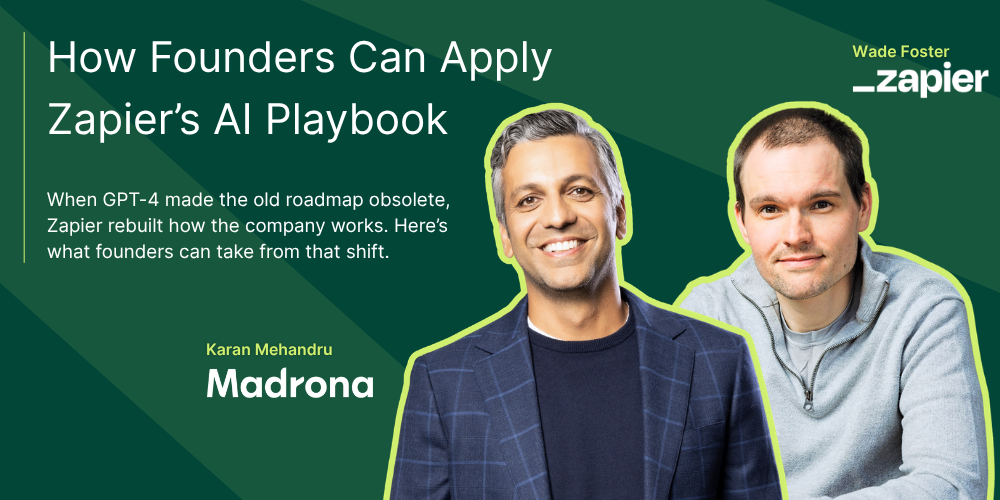
Every founder remembers their first “this changes everything” moment inside their own company. The shift that touches the product roadmap, hiring plan, and economics all at once. For Zapier, that moment came six months after ChatGPT made waves in the news, when GPT‑4 launched and forced CEO Wade Foster and his team to realize their existing roadmap and operating model may no longer be sufficient.
From the outside, nothing was obviously broken. Zapier was already a wildly successful, scaled startup with a durable SaaS business that had been delivering strong growth for over a decade. Inside Zapier, though, the magnitude and speed of improvement from GPT‑3.5 to GPT‑4, and the associated cost drop, made it obvious the old roadmap wouldn’t survive what was coming.
Today, Zapier is at several hundred million in ARR with roughly 800 employees and more AI agents than humans working across the company. In a recent fireside conversation with our portfolio CEOs, Wade walked through his decision in 2023 to rethink his roadmap, org design, and business model for the AI era.
As one of the early investors in Zapier and a longtime friend of Wade’s, I’ve had the privilege of seeing and supporting his journey as a founder and friend from 500k in ARR to hundreds of millions in ARR, and he shared incredible wisdom in our conversation. I want the entire founder community to benefit from the emotional and intellectual undertaking that Wade and his team led that turned AI’s existential threat into a generational opportunity.
I hope this tactical guidance helps founders at every stage and sector.
When to call “code red”
Zapier had been experimenting with AI well before ChatGPT launched in November 2022. Wade’s co‑founders built a text bot, which made the company treat ChatGPT’s launch as a “cool product” moment rather than a strategic earthquake. Product teams added early AI capabilities, like letting customers insert a ChatGPT step inside a Zap, but the response was organic and incremental.
But when GPT‑4 launched that March, it was clear to Wade that the world would never be the same. The jump in capability over GPT‑3.5, the sharp drop in cost, and the fact that both happened in less than six months made the status quo feel not only precarious but already in flux. As Wade put it, if the next six months were even a fraction as intense as the last six, the impact on the whole ecosystem would be “massively disruptive,” and Zapier’s existing roadmap and operating model would not be enough. That was the point where he used language the company had never used internally before: “code red.”
What made the next step harder as a company was that nothing in the headline numbers demanded a change. Zapier wasn’t a turnaround story; it was a durable, capital‑efficient business where growth was solid and customers were renewing. When your chart is clearly trending down, radical change is psychologically easier because you have no choice. When you are doing well, or even okay, you and your team can easily talk yourselves into preserving the status quo.
What other founders should think about: your “code red” moment is unlikely to show up first in your P&L. It will show up as a step‑change in what’s possible for your customers and competitors. When that happens, the real question is not “can we keep growing on the old roadmap,” but “if we don’t move now, what happens when a peer decides to rebuild around this while we stay put?”
Make AI everyone’s job without losing the company
Zapier’s first big move post‑GPT‑4 was not a new strategy doc. It was a full‑company hack week. The team stopped normal work and asked every function to build with AI. Before that week, about 10% of Zapier employees used AI with any regularity. After it, more than half the company did, and they now repeat similar hackathons every four to six months to keep mental models current. The aim was simple: get as many people as possible using AI directly in their day‑to‑day work before asking the org to make bigger AI‑driven bets.
This phase was uncomfortable. Employees worried they were “throwing a bunch of stuff at the wall” without a settled strategy. Some people chose to leave; others were asked to leave when it became clear they preferred the old way of working. Wade’s message, repeated often, was that the alternative — keeping the company AI‑light in a world that was going AI‑heavy — would be far worse for everyone’s careers. He also made peace with the fact that this was not a one‑quarter project; it took six to twelve months of repeated hackathons, show‑and‑tell, and “builder opportunities” to transform how the company worked.
One unexpected catalyst in this phase was HR. Zapier’s Chief People Officer, Brandon Summut, took on the role of Chief People and AI Transformation Officer because his team was out in front on AI adoption and he was already skilled at cross‑functional change management. That move reflected a broader reality Wade kept returning to: the hard part of AI is not calling APIs, it is the human side: changing how functions work, how people are evaluated, and how the organization digests constant reinvention. To accelerate learning, Zapier was deliberately “promiscuous” with tools, buying from multiple labs and applications so teams could cross‑pollinate ideas and bring the best interaction patterns back into their own product.
What other founders can try: don’t try to jump straight from “no AI” to a perfect AI strategy. Start by setting an adoption target (for example, “a majority of the company using AI in their weekly work within a quarter”) and run a time‑boxed, company‑wide build week to get there. Make it easy to experiment by unblocking access to tools, sharing lightweight demos, and being explicit that this will feel messy at first. Then assign a senior operator to own the change‑management work of turning those experiments into new ways of working over the next 6–12 months. That leader could and should come from anywhere in the organization.
Rebuild systems and pricing for an agent‑first world
Once baseline literacy improved, Zapier shifted from scattered experiments to deeper systems change. One example Wade shared was engineering. As AI made it easier to generate code, the bottleneck moved to code review and deployment, which still ran on human timescales. To unlock the benefit, they had to redesign code review so agents handled the bulk of it; time‑to‑ship dropped from days to minutes. That required new tooling, new guardrails, and new norms across the entire engineering org, not just one team.
Zapier is applying a similar pattern to the workflows its customers run. Wade’s view is that the build phase should lean on a probabilistic agent that can go back and forth with a user to discover the right workflow, but once that workflow works, it should be compiled into something deterministic, including code, Zaps, or other structured automations, that enterprises can govern and trust to run the same way every time. For conservative customers and regulated verticals, that separation between creative experimentation and deterministic execution is what makes agents feel safe enough to own core work.
Pricing went through a similar rethink. Zapier had always had some usage‑based component, but over time, the plan matrix had become confusing. Some plans allowed usage‑based expansion, others forced customers to jump tiers, and many users felt they were being nickel‑and‑dimed. In 2024, Zapier simplified everything around tasks:
-
- Customers buy a subscription tier defined by a bucket of tasks.
- When they exceed it, they can either upgrade to the next tier or pay as they go at a slightly higher per‑task rate.
Underneath that change is Wade’s view of how software consumption is shifting. He expects more work to be done by agents than humans, and for agents to effectively “choose” which tools to call based on tokens and APIs. In that world, seat‑based pricing looks fragile. The software may still be valuable, but the number of human seats required goes down as agents absorb more of the work.
What other founders should think about: look for the bottlenecks that emerge after you add AI, not just the ones you had before. Where has the constraint moved (to review, QA, onboarding, governance)? Start by redesigning one or two of those systems so agents are in the loop by default. In parallel, pressure‑test your pricing model against a future where the primary “user” is an agent. If your economics depend on seat counts, assume they will come under pressure as your customers’ own agents take on more work.
Update who you hire and how you decide
AI adoption did not move evenly across Zapier. Functions where AI had obvious leverage, like greenfield engineering and internal tooling, moved fastest. Teams led by managers who were personally hands‑on with AI also tended to move further and design bolder changes.
This forced Zapier to update its view of what “strong leadership” looks like. The leaders thriving there now share a few traits:
-
- They use AI directly in their own workflows.
- They are willing to tear down and rebuild systems rather than defend legacy processes.
- They see AI as a core teammate, not a side project.
By contrast, managers whose main strength was scaling an existing playbook, or whose primary contribution was sharp critique, are less aligned with what the company needs now. As Wade pointed out, AI is becoming a strong critic in its own right.
He introduces tactics like a “hiring council” (a set of AI personas that review Ashby scorecards as a kind of internal bar‑raiser), which have been deployed internally and surface missing owners, weak plans, or incomplete data in a way that looks a lot like a good internal reviewer.
The hiring council itself is a good example of how founder rituals and workflows are changing. Wade still approves each hire and audits whether the process has truly held the bar. To scale that, he built a workflow where an AI council with different personas independently reviews the candidate’s materials, synthesizes its views, generates a Google Doc, and shares it with the hiring team in Slack, all orchestrated through code and Zapier’s own tools. What began as a manual copy‑and‑paste exercise is now an AI‑native workflow wrapped in guardrails.
What other founders should do: take an honest look at your leadership bench and ask who is already building with AI versus who is watching from the sidelines. Bias your next promotions and hires toward the former. Then pick one high‑stakes founder ritual, whether that be hiring, roadmap review, pricing changes, and design an AI‑assisted version of it. The goal is not to remove yourself from the loop, but to embed AI into the decision‑making fabric of the company.
How Founders Should Respond
Zapier’s experience is one concrete path, but the underlying questions are the same for every founder building in the AI era. Zapier did not wait for growth to stall or for competitors to force its hand; it used a catalytic moment to re‑examine its roadmap, its org, and its business model from first principles and then made the uncomfortable changes early.
For founders, the question is not whether you will face your own version of Zapier’s “code red.” The question is, when your “code red” happens, will you recognize it with enough speed and seriousness to turn the threat into an opportunity?
The companies that endure in this era won’t be the ones with the flashiest AI features or trendiest tech, they’ll be the ones whose leaders used those features to improve how decisions get made, how work gets done, and how value flows through the system for their customers and inside their own walls.
If you’re a founder navigating your own moment of reinvention or reacceleration, I’d love to hear how you’re approaching it. Feel free to reach out and share your experience at [email protected].
Related Insights