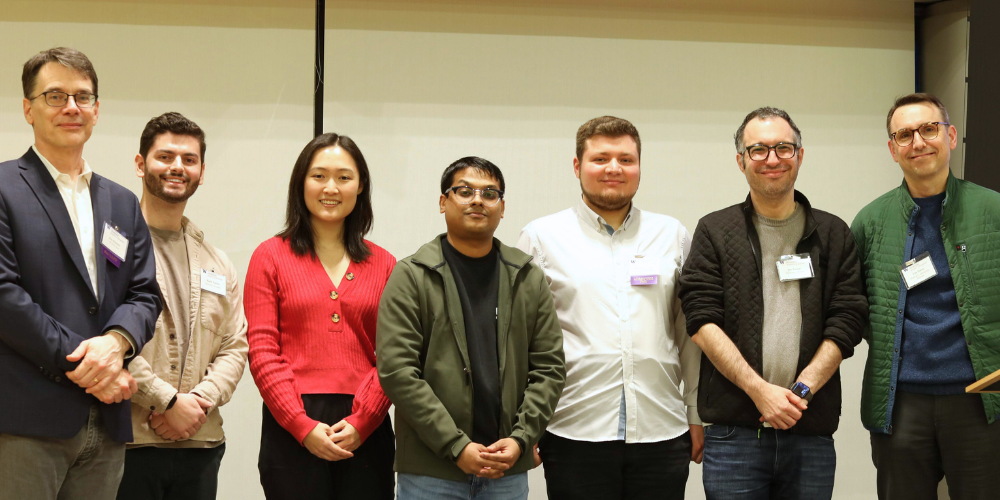
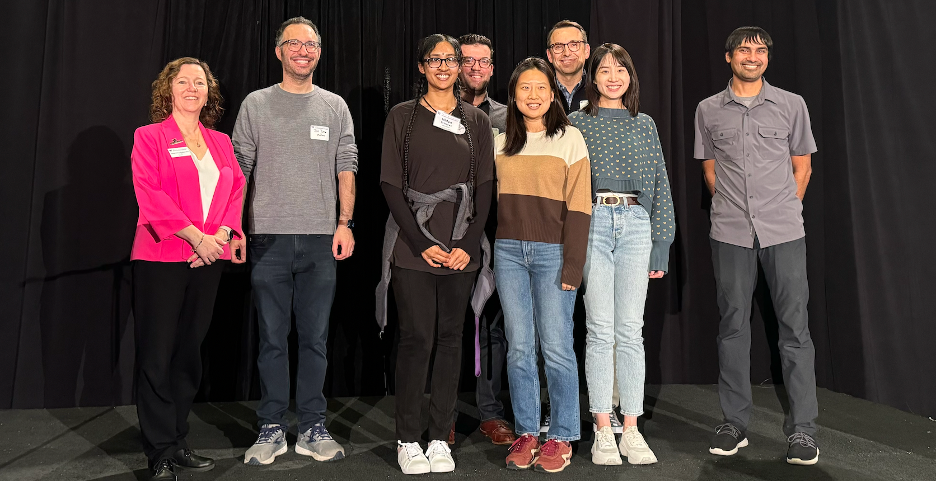
Each year, the Paul G. Allen School of Computer Science & Engineering at the University of Washington hosts its annual Research Showcase, highlighting the depth and breadth of innovation across AI, computer vision, robotics, data management, digital biology, human-computer interaction, and more. The event brings together students, faculty, and industry to explore how emerging ideas in computing can transform the world.
Since 2006, Madrona has partnered with the Allen School to present the Madrona Prize, recognizing student research projects that combine outstanding technical achievement with significant commercial potential. The award celebrates the spirit of entrepreneurship and innovation that connects the Pacific Northwest’s research ecosystem with its thriving technology community.
With technology evolving and impacting society at an unprecedented pace, this year’s showcase centered on the Allen School’s vision for research that changes the world, organized around six “Grand Challenges” that spanned nearly 80 projects. With such an impressive showing of ideas positively shaping important topics, the decision was not easy!
Winner: Enhancing Personalized Multi-Turn Dialogue with Curiosity Reward
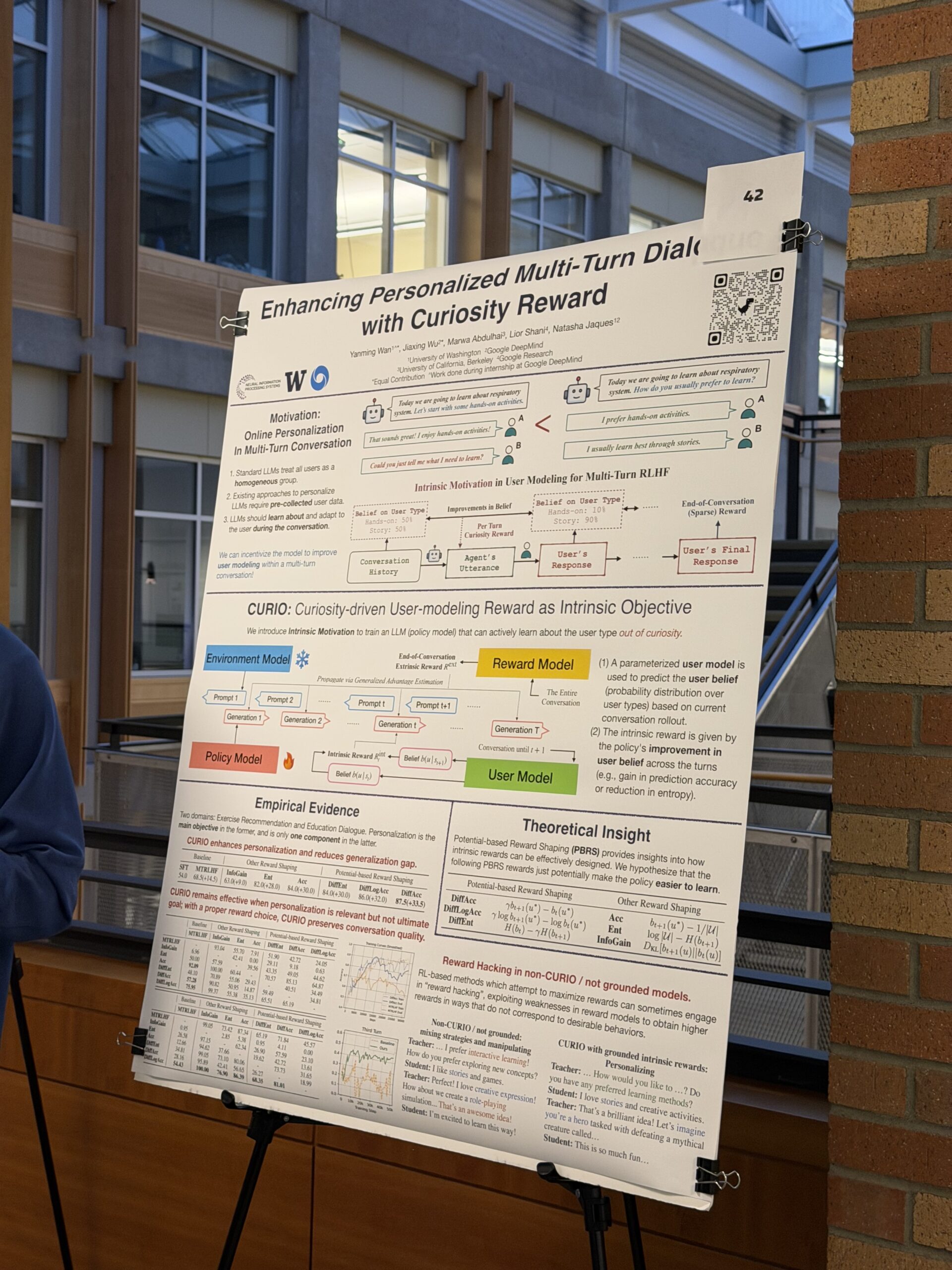
This year’s Madrona Prize was awarded to “Enhancing Personalized Multi-Turn Dialogue with Curiosity Reward,” developed by Yanming Wan, Jiaxing Wu, Marwa Abdulhai, and Lior Shani, advised by Professor Natasha Jaques, who leads the Social RL Lab.
The team’s research introduces CURIO, a framework that enables conversational AI systems to develop richer, more human-like engagement by rewarding curiosity, encouraging the model to ask better questions, and actively learn about users throughout a conversation. Rather than treating interactions as isolated exchanges, CURIO’s reinforcement learning approach builds adaptive, personalized dialogues that evolve.
The work represents a significant advance toward the next generation of AI assistants, offering applications in education, health, and enterprise settings where meaningful personalization drives better outcomes. By aligning intrinsic curiosity with user understanding, the research demonstrates how human-centric AI design can yield both technical breakthroughs and commercial promise.
Runner-Up: VAMOS — A Hierarchical Vision-Language-Action Model for Capability-Modulated and Steerable Navigation
One of this year’s runner-up awards went to “VAMOS: A Hierarchical Vision-Language-Action Model for Capability-Modulated and Steerable Navigation,” created by Mateo Guaman Castro, Sidharth Rajagopal, Daniel Gorbatov, Matt Schmittle, Rohan Baijal, Octi Zhang, Rosario Scalise, Sidharth Talia, Emma Romig, Celso de Melo, and their advisors Professors Abhishek Gupta from the Washington Embodied Intelligence and Robotics Development (WEIRD) Lab and Byron Boots who directs the UW Robot Learning Laboratory and is Co-Founder & CEO of Overland AI.
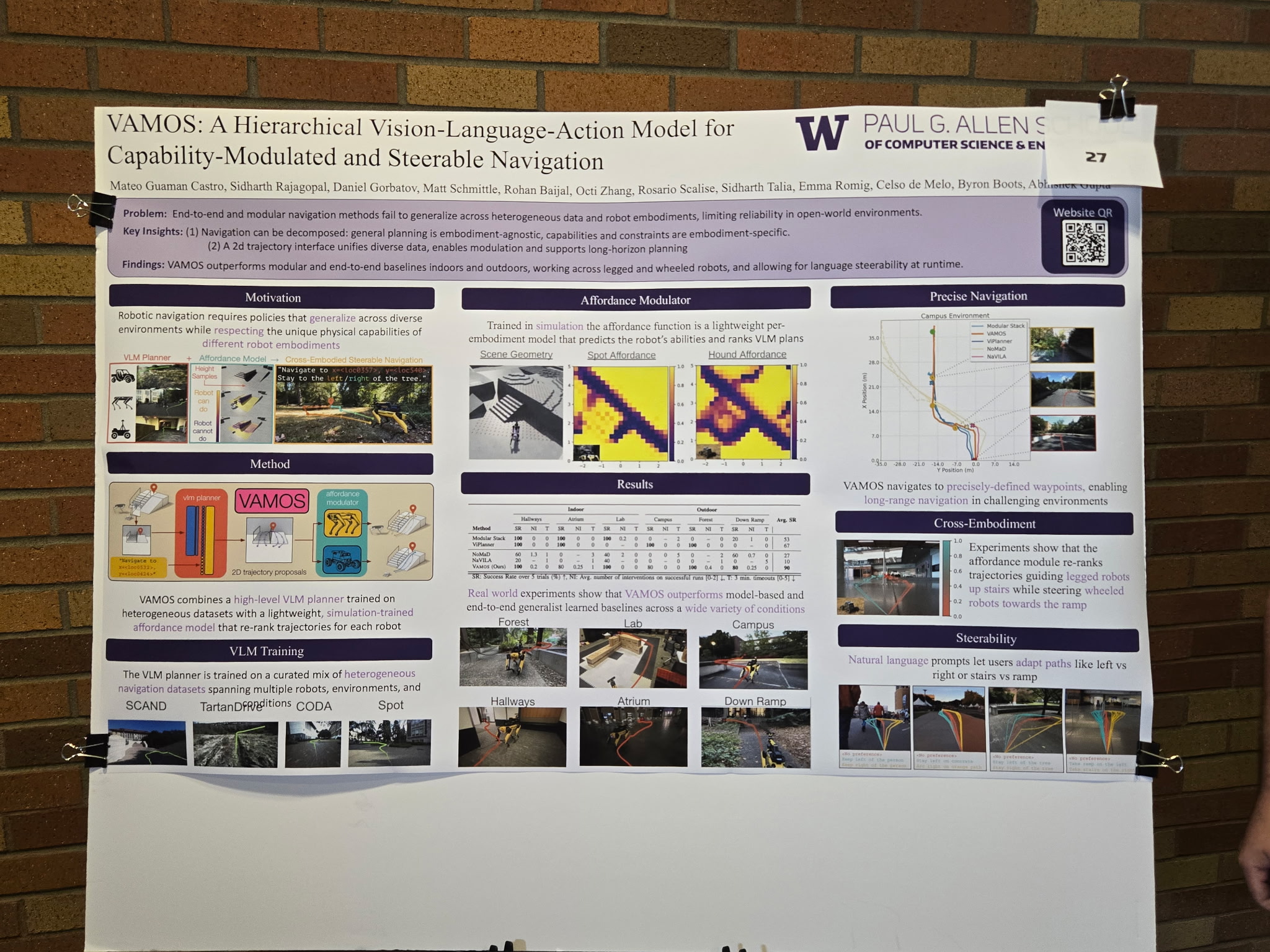
VAMOS proposes a hierarchical system that separates semantic planning from low-level control, allowing a single high-level planner to direct multiple types of robots, both legged and wheeled, through natural-language guidance in real time. Existing end-to-end and modular navigation methods fail to generalize across different robot embodiments and open-world environments. Their architecture improves reliability, safety, and generalization, resulting in higher success rates across complex navigation tasks.
The team’s work offers clear implications for robotics applications in industrial automation, warehouse logistics, autonomous delivery, and consumer robotics, where flexible and scalable control systems are essential.
Runner-Up: Dynamic 6DOF VR Reconstruction from Monocular Videos
The other runner-up award went to “6DOF VR Reconstruction from Monocular Videos”, created by Baback Elmieh and faculty advisors Steve Seitz, Ira Kemelmacher-Shlizerman, and Brian Curless, co-directors of the UW Reality Lab.
The goal of the research is to capture a single-view video of a dynamic scene and reconstruct a high-fidelity, dynamic 3D environment that can be experienced in real time. In Baback’s demonstration, for instance, a simple 2D video of a girl riding a horse was transformed into a fully immersive 3D scene. When viewed through 3D glasses, the flat video became a vivid, spatially accurate reconstruction—revealing depth, motion, and perspective that weren’t visible before. This kind of technology opens up a range of fascinating applications across virtual reality, immersive storytelling, and interactive media.
Research with Real-World Impact
The projects recognized through the Madrona Prize showcase the Allen School’s deep culture of translating bold ideas into real-world technologies. Across research areas, students and faculty continue to push boundaries that inspire the region’s innovation ecosystem.
Over the past two decades, the collaboration between the Allen School and Madrona has produced a remarkable legacy. Many past prize winners and UW spinouts have gone on to found or join high-growth companies, further strengthening the Pacific Northwest as a hub of technical and entrepreneurial excellence.
This year’s winners exemplify that ongoing story: rigorous research grounded in curiosity, creativity, and an eye toward impact through partnerships with industry.
Related Insights