In 2012, when AWS hosted its first re:Invent in Las Vegas, it was a scrappy developer gathering rather than the global innovation spectacle it has become. A few thousand engineers and startup founders crowded into conference rooms to debate the future of infrastructure, not marketing slogans, but something more elemental: The idea that general-purpose computing and storage could become infinitely scalable, elastic, and reliable when managed by a service provider. AWS led the way then and remains the market leader today.
Madrona was there 13 years ago and has been highly engaged every year since. We’ve watched re:Invent grow from a developer-focused technology summit into the gravitational center of cloud computing innovation. Along the way, companies like Snowflake, Databricks, Datadog, Twilio, and Wiz emerged to leverage cloud capabilities and solve customer problems better than ever before. And, the same major enterprise companies that swore they would NEVER use the cloud in 2012 all spend $100 million+ annually on web services.
Perhaps not coincidentally, 2012 was also when we began investing in companies like Turi and Placed that were leveraging data and machine learning to deliver differentiated ML applications. Today, AI models are powering what we call “The Reasoning Revolution,” including pre- and post-training and inference, along with all the tooling needed to build and deploy intelligent applications.
Customers of all sizes are pressing AWS and other cloud providers to meet their changing requirements for AI-native and AI-enhanced solutions. And, more rapidly in this cycle, enterprises are investing proactively to generate the greatest topline and bottom-line value they can from AI-driven innovation. This revolution is actually a super set of all the innovation in cloud services (including accelerated computing), data management, and algorithmic approaches to learning. The cloud phase of the technology revolution gave us computing on demand. The next revolution is giving us reasoning on demand.
There is a ton of focus in the public and private investor community on the amount of CapEx being deployed to expand AI-capable data centers. Everything from energy, facilities, GPUs, and other networking infrastructure are required to build out the capacity demanded. But the ultimate question is not about circular deals or bubbles; it is about value creation and capture! That value capture, for both the AI solution providers and their customers, will come from building and using reasoning machines and reasoning flywheels.
Reasoning Machines and Flywheels
Reasoning machines are not just AI models. They are orchestrated systems that understand goals, use tools, and learn from outcomes. Think of them as software-defined colleagues capable of co-reasoning with humans, not just generating outputs or automating tasks. Each interaction creates new data that improves the system, forming what we call a reasoning flywheel: An intelligent loop where insight leads to action, and action leads to better data and insight. These flywheels are at the core of AI value capture.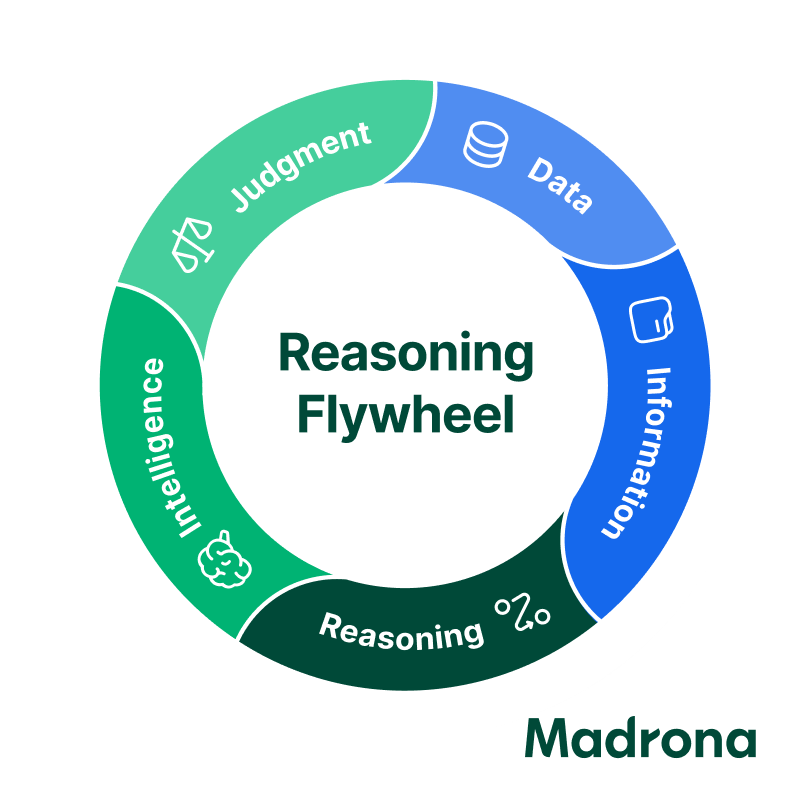 The compounding effect is what makes this era so different. The cloud era gave us scalable infrastructure. The reasoning era gave us scalable intelligence that’s contextual and gets better with use. We’re already seeing reasoning machines shape industries from legal (Harvey, EvenUp) to marketing (Writer, Gradial) to customer service (Sierra, Decagon) to knowledge access and management (Glean, Read AI). The pattern repeats across categories: data + reasoning + workflow + engagement beats isolated or overly generalized models every time.
Companies like Gradial are pioneering intelligent applications that solve specific enterprise problems. Gradial will be featured at AWS this year for solving some of the world’s largest enterprises’ marketing operations challenges with reasoning machines powered by diverse models (including Amazon Nova, Anthropic Claude, and Open AI models) and other AI tools. These AI-native companies aren’t just building innovative products; they’re building reasoning systems designed to get better with daily customer engagement.
Why It Matters for Founders
For founders, the message is clear: The least capable reasoning machine you’ll ever create or use is the one you’re using today.
Every well-architected system compounds. Each user interaction becomes future training data. Each workflow becomes an opportunity for new data capture. The companies that design for that flywheel, where human feedback and machine learning reinforce each other, will define the next decade of value creation and capture.
At its core, three distinct data types are leveraged: latent, contextual, and engagement data. Latent data is the combination of underutilized structured data and previously inaccessible unstructured data that has been thought of as secondary to the primary function where that data was created. It could be a legacy database, server logs, communications data from endless emails, Slack threads, or video meetings. Contextual data often comes from established “systems of record,” profile databases, or even spreadsheets that contain valuable data and metadata. But in the end, the most important data types will be multimodal engagement data from users interacting with “bootstrapped” versions of reasoning machines that enable those machines to help human collaborators all the more!
What “Overnight Success” Happens Next?
While re:Invent only started 13 years ago, AWS initially launched almost 20 years ago. So, when over 50,000 people gather in Las Vegas next week, I expect there will be a mix of people who wonder why cloud computing’s impact has taken so long and others who will marvel at the fastest $125 billion+ revenue business ever built.
However, today we are in an era where technological optimism and economic momentum reinforce each other; where capital, creativity, and capability are compounding. The organizations that master this shift will be those that use it to improve how they build their products, operate their companies, and collaborate in the broader ecosystem.
This is about navigating The Reasoning Revolution: A moment where cloud builders become intelligent application and agent builders, and where the partnership between humans and machines defines the next decade of innovation.
That’s the journey we’ll be exploring together at re:Invent 2025: How to navigate the reasoning revolution, and how this next wave of reasoning machines will reshape how we discover, evaluate, and take action in our personal and professional lives.
Related Insights