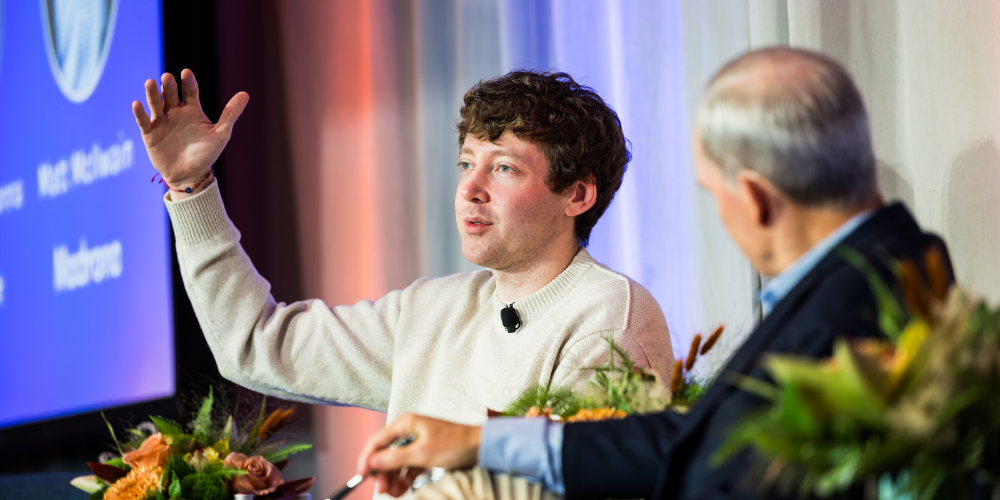
In my 25+ years of investing, I’ve seen a set of three common traits shared by the most successful founders and the most successful executives: genuine curiosity, triangulating toward decision making, and a bias toward action. Microsoft EVP Charles Lamanna is a founder turned senior executive leading one of the most important transformations in recent memory at Microsoft, and he has landed on a similar set of lessons along the way. At our fifth annual IA40 Summit, he told our standing-room-only audience about the skills he honed as a founder and how he’s worked to translate these mindsets among his teams of thousands of Microsoft product builders.
We’re releasing all our IA40 Summit
conversations on YouTube.
I’ve known Charles since he left Microsoft after 3 years as a young software developer to start MetricsHub, which went through Techstars here in Seattle, a program Madrona helped build. MetricsHub was acquired by Microsoft a year later. Today he is EVP of Copilot, Agents, and Platform, and his group builds the core Copilot and agent platform along with Office, Teams, SharePoint, OneDrive, Power Platform, and Dynamics 365. When I sat down with him at the 2026 IA40 Summit in September, I asked what he brought back from his startup days and how it shapes the way he runs one of the most important organizations at Microsoft.
Three ideas from our conversation stood out to me as founder habits that can translate particularly well at enterprise scale, and each connects to the three traits I look for:
- Staying close to customers (key to genuine curiosity)
- Owning outcomes without waiting for permission (calls for making decisions with imperfect information)
- Moving fast (a bias toward action)
I’ve witnessed that these qualities are important at any stage, but they become elusive as organizations scale. Despite having far more resources, these habits tend to fade as layers of process build up between the people making the product and the people using it. The leaders who carry startup habits into big organizations can change what those organizations are capable of, and AI is giving them new ways to do it.
Customer obsession
At a startup, nothing stands between the founder and the customer. At Microsoft, Charles has to create that closeness. “When you’re an entrepreneur and you have your own company, you can’t hide behind anything,” he said. “You’re confronted with the harsh realities of the market and customers and what you can and cannot do all the time. And that makes you really develop this incredible customer empathy.” In a company Microsoft’s size, he said, there can be so many layers between a team and its users that people lose sight of the pain points.
That lesson became central when he moved into Microsoft’s application businesses, including Dynamics 365, Power Platform, and later Microsoft 365. He still pushes engineers out of the building to go talk to customers. If a team works on contact center software with a customer like HP, he wants engineers to go to HP, sit in the call center, and learn how people use the product. Customer feedback also shaped one of Microsoft’s biggest recent launches. When Charles walked a customer through the separate Copilot features Microsoft had been piloting, the reaction was “That’s way too complicated.” That kind of feedback reinforced Microsoft’s direction towards a more integrated Copilot experience, described as the “new Copilot” where people don’t have to think about which individual AI capability to use. They announced new capabilities a week before the Summit.
“People want one big integrated AI app,” Charles said. “They don’t want seven AI apps.”
High agency
The second lesson was agency. When Charles first joined Microsoft out of college, he saw how easy it could be in a large organization to feel constrained by dependencies, approvals or resources. Building a company changed his perspective. “There’s no concept of that when you have your own company,” he said. “You just have to find a way to make it work.”
His example was Azure, where MetricsHub landed after the acquisition. At the time, Azure did not offer virtual machines, Google Cloud did not exist, and Azure ranked around seventh or eighth among cloud providers, behind companies like Rackspace. Nothing guaranteed it would become what it is today. Charles credited Scott Guthrie’s leadership, and said Azure succeeded because it found a way to get to yes inside a company that had been a software business for 35 years and now needed to commit billions of dollars to capital spending.
Speed
The third lesson is the one AI has made urgent. Every year Charles writes a “state of the business” paper for his organization, and this year the top priority was changing how the team builds products. “The profession today looks absolutely nothing like it did 12 months ago,” he said. Engineers who used to write code by hand now work in terminals and custom apps that manage their agent swarms, and some talk to their computers by voice.
The results show up in speed. Charles said he is seeing examples within his organization where small groups of people can accomplish work more quickly. Charles described a shift towards more general-purpose, full-stack builders who can increasingly work across design, customer research, front end, back end and deployment. “All the coordination cost is gone,” he said.
The challenge now is scaling those new ways of working across a large organization. Microsoft, Charles said, has to “transform in place” because the combination of AI expertise and deep knowledge of Microsoft’s businesses, architecture and services can’t simply be hired from outside.
More from the Summit
Charles also shared his view on where software and its business models are headed.
Thin apps go headless. Charles offered a bold framework for thinking about the future of software: “thin” apps that users visit briefly could increasingly become headless services behind AI super apps, while “thick apps where people spend much of their working day retain a more direct user experience. That carries a pricing risk. “If my agent interacts with your app exclusively, the agent’s your customer, not the end user,” he said. “And agents are very harsh customers.”
AI economics are changing software business models. Charles said that because AI carries meaningful consumption costs, providers will increasingly need business models that account for usage alongside, or instead of, traditional per-user licensing.
Microsoft as platform partner. Microsoft is known as the definitive platform company. And this approach will continue to be true in the AI era. Charles said Microsoft will not try to build in every AI domain. Its plugin marketplace uses the same standards as Claude and ChatGPT, so partners can build once and run in all three. He pointed to Windows as the model: a platform where the economic value created by companies building on it far exceeds what Microsoft itself captures from the platform.
Charles ended where the conversation began: with advice rooted in his own experience as a founder. His advice to founders was to lean into who they are and what genuinely excites them. For business leaders, his advice was equally direct: “swim and live and breathe with your customers as much as possible.”
This year’s keynote with Charles was part of the 2026 IA40 Summit, where we also heard from leaders at Anthropic, AWS, Salesforce, Stripe, and many of this year’s IA40 winners. Keep an eye on our YouTube for all of our Summit coverage. And don’t miss our conversation with Charles from last year.
Related Insights