Today we’re excited to share a new, deeply researched analysis of the latest patterns in AI adoption among the enterprise. As every AI builder is striving to find durable and scalable market positions, these insights demonstrate the common obstacles to deep enterprise adoption, and the commonalities among the companies who are most successful at it.
Informed by a new survey of 150 senior enterprise decision-makers, we have summarized the key findings in this post, and full report can be downloaded here.
Crossing the pilot chasm
Enterprise AI has never had more money behind it. According to our survey, 74% plan to expand AI budgets over the next 12 months. Nearly half now carry a dedicated, net-new AI line item; AI has graduated from innovation experiment to distinct spending category.
Then there’s the number that should reorganize how founders think about their go-to-market: 83% of those same enterprises converted fewer than half of their AI pilots into production over the last 12 months. More than a third converted fewer than one in four. Just 1% got past three quarters.
That gap — between committed budget and realized deployment and enterprise value — is the defining dynamic of enterprise AI in 2026, and the subject of our inaugural report. We draw on a proprietary survey of enterprise buyers, a practitioner survey of engineering leaders from our builder community, and five years of longitudinal IA40 list data to unravel the enterprise decision-making, builder, and capital perspectives on where AI adoption is taking hold.
Here’s what stood out.
Navigating the enterprise gauntlet
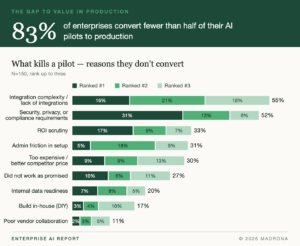
The instinct when a pilot stalls is to assume the technology underdelivered. The data says otherwise. “Didn’t work as promised” ranks sixth among reasons pilots fail to convert.
What actually kills pilots is everything surrounding the product: integration complexity ranks first, followed by security, privacy, and compliance requirements, and ROI scrutiny third. Pilots don’t die in the demo. They die in the gauntlet of integration, compliance, procurement, and organizational buy-in that comes after.
What tips a pilot into production
Strong end-user adoption and feedback is the #1 factor tipping the decision to scale, ranked ‘top three’ by 65% of buyers — slightly ahead of executive sponsorship and seamless integration. Clear, quantifiable ROI comes fourth when making the purchasing decision.
That ordering matters more than it first appears. By the time the formal ROI analysis happens, the decision has usually already been made informally. Bottom-up user love creates the internal demand. An executive champion provides political cover. Clean integration removes the objections. The ROI case ratifies what people already believe.
The playbook is easier to state than to run: make users love it, cultivate an executive champion, integrate cleanly, and build the ROI case in parallel.
Buyers want outcomes but are sold consumption.
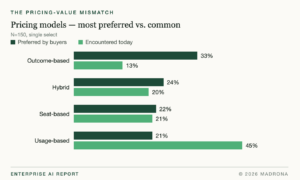
Outcome-based pricing is the most preferred model among enterprise buyers but the least commonly encountered. Usage-based pricing runs the opposite direction: nearly half of buyers primarily encounter it, but fewer prefer it.
The takeaway is that usage isn’t working as a proxy for value. It carries neither the clear outcome alignment buyers want nor the budget predictability that seat-based and hybrid models offer. Value-based pricing is genuinely harder to operationalize. But for founders willing to do it, the gap is a structural GTM advantage over competitors still charging per token.
Fast in, fast out
The good news is that AI sales cycles have compressed. 52% of deals close in under six months from first meeting to signed contract.
The back end is harder: 77% of enterprises re-evaluate their AI vendors at least every six months, including 29% that do it on a rolling basis. Annual and multi-year contracts used to provide a moat of inertia. In enterprise AI, switching costs are lower and the re-evaluation cadence is relentless. Landing the deal is the beginning, not the end — founders need continuous value demonstration built into the product itself to make it through renewals.
Adoption is driven by practitioners, not sales
Discovery is overwhelmingly bottoms-up. 41% of enterprises primarily find AI tools through internal tech-team research.
The “land” doesn’t happen in a boardroom. It happens when a practitioner finds your tool, proves it works, and creates internal demand. Product quality, community, and word of mouth are important feeders into the enterprise AI sales motion.
Also in the report
- Where value is versus where the investment is going. Code generation is by far the highest-value AI workflow in technology functions today, but enterprise have different priorities for where they want to invest in next. We also dive into usage vs. investment gaps in the back office and GTM functions.
- Five years of IA40 data. The lists have seen high turnover. Only Databricks has made all five years. The 2024–2025 winners raised $366B — nearly a third of all venture dollars raised over the last two years.
- The vendor landscape. Microsoft leads on distribution with 78% paid penetration; Anthropic leads on satisfaction with an NPS of 8.4.
- The workforce shift. 83% say AI is reshaping their workforce, but the dominant response is rewriting job descriptions at stable headcount, not cutting.
- A six-point founder playbook for building products and GTM motions that survive the re-evaluation treadmill.
The enterprise AI market is enormous, growing, and backed by committed budgets, but the bar for moving from a pilot to a scaled production contract has never been higher. The purpose of this report is to help founders navigate not only what enterprises say they want, but the reality of how and what products actually get bought, what enables a pilot to scale into production, and where enterprises are investing real dollars.
For further insight on harnessing the value of AI, go here.
Read the full report here.
Related Insights