Over the past year, the applied AI market has put an increasing emphasis on delivering tangible value and has seen a significant rise in compelling outcomes. SpaceX acquired Cursor for $60 billion, Google acquired Wiz for $32 billion, OpenRouter was acquired for roughly $7 billion, and Nvidia is reportedly acquiring HuggingFace for $12.9 billion. All of these companies are past or current IA40 winners! The age of experimentation is giving way to an age of enterprise readiness, where buyers and investors are paying premiums for companies that can demonstrate real ROI: hours saved, revenue generated, work completed, and entirely new capabilities brought into production.
At the same time, the value of AI is not accruing to models alone. As frontier models become more capable and increasingly commoditized, more value is being created in the harnesses and aggregation layers around them. Cursor is building an agentic coding environment that brings together the best available models and tools under one interface, while OpenRouter aggregates and routes across models. Hugging Face, which hosts and distributes models, would give Nvidia a stronger position in the layer between its chips and the developers deploying AI. And, several “inference as a service” companies are raising later stage capital at multi-billion dollar valuations. The broader theme is that companies are increasingly looking to capture value not just by building the underlying intelligence models, but by building agentic systems and controlling strategic layers through which customers access, deploy, use, and measure them.
These shifts are what Madrona’s 6th annual Intelligent Applications 40 list, released today, captures. We see it as the year of “Harnessing the Value of AI,” and this theme runs through the 5th annual IA40 Summit, where a number of this year’s winners will take the stage. Nearly every category and cohort includes at least one company applying AI agents to a specific job to be done: IT service management with Serval, customer service with Sierra, marketing operations with Gradial, lead generation/sales with Clay, legal work with Legora, healthcare with OpenEvidence.
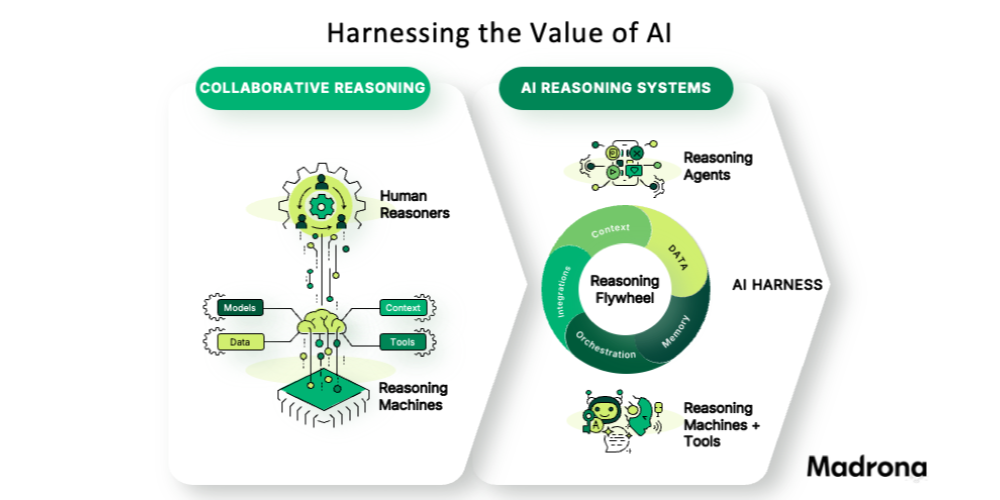
These are agentic systems of execution, each connecting an agent to the right context, models, and tools to complete a specific job: code written, a ticket resolved, a contract reviewed. The same principle extends throughout the stack. The winners will be the companies that can connect AI capability to an end customer and prove the ROI, whether they are building the application, aggregating models, providing the infrastructure, or supplying the compute and power underneath it.
That bar is getting harder to clear, and it’s starting to show in who retains their spot on the IA40. Of last year’s 40 winners, 23 repeated this year, a 58% repeat winner rate, up from 33% the year before. That’s a sign of growing durability in this year’s list, especially among Enablers and Late-stage companies, rather than the turnover we’ve seen in past years. Databricks remains the only company to appear on all six IA40 lists since it launched in 2021.
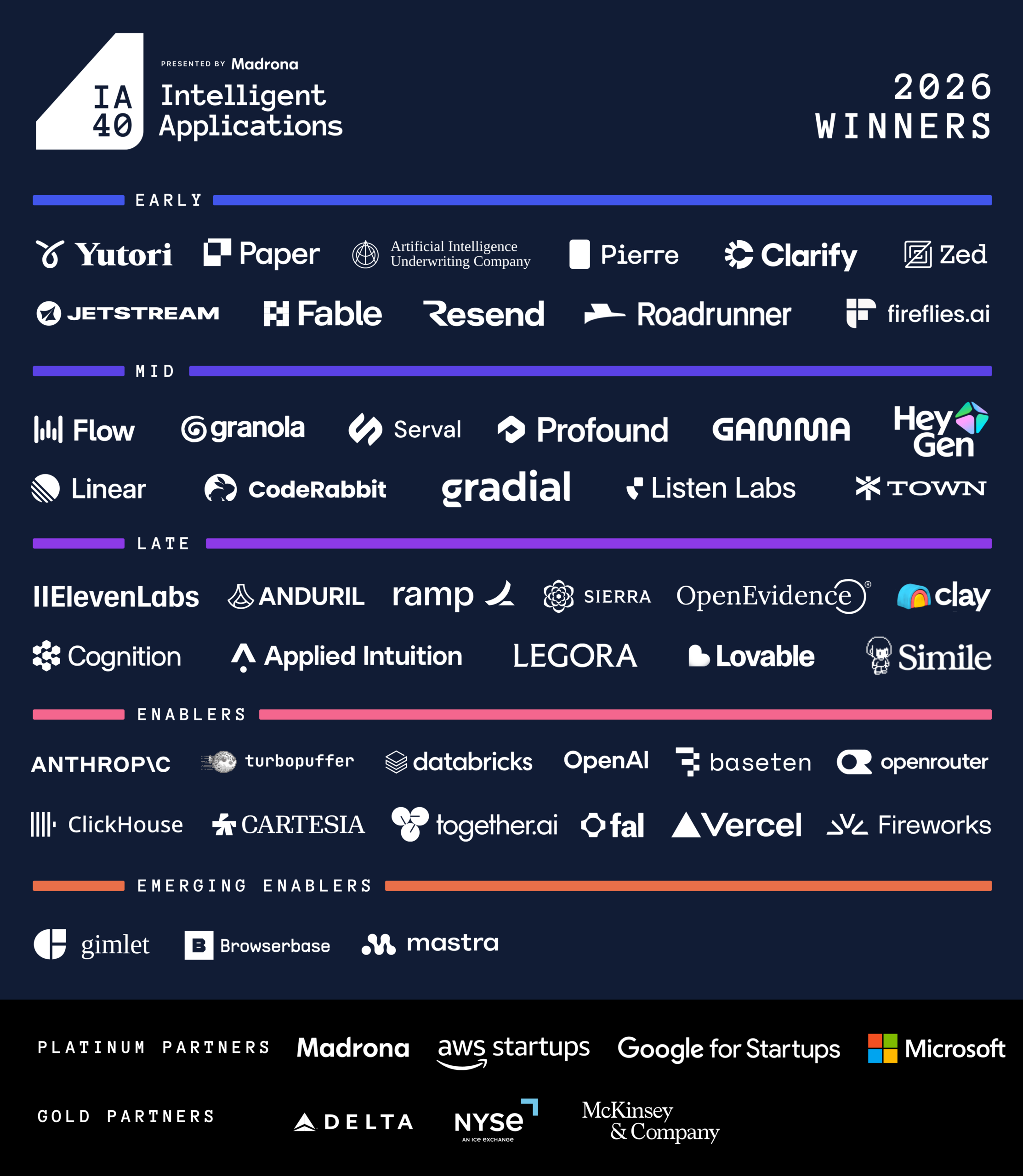
We surveyed the VC community to arrive at 45 2026 winners this year – more than our usual top 40, as there were multiple effective ties across the categories. Together, the 45 2026 winners have raised $410 billion since their founding, more than 25 times the roughly $16 billion the inaugural 2021 cohort had raised by fall of 2021. That $410 billion isn’t spread evenly. Anthropic, OpenAI, and Databricks together account for $377 billion or 92% of it. The other 42 winners have raised $34 billion combined, averaging over $800 million each. Collectively, across all six years, 164 unique companies have made the IA40, and raised $508 billion since their founding, not including IPOs or acquisitions.
Widening the lens to both this year’s and last year’s cohorts together, the winners raised $303B in the last 12 months alone, representing roughly a third of the $902B in total global venture capital raised over the same period. Anthropic, OpenAI, and Databricks accounted for $281B, or that same 92% of the cohort’s total. Excluding these three companies, the remaining 43 winners raised $23B combined, or an average of $528M each, a different order of magnitude from the frontier labs and infrastructure giants at the top of the list – but still a substantially greater some of capital per company than historical amounts.
That concentration is also changing shape. Databricks raised $7 billion in February at a $134 billion valuation, then raised another $5 billion in August at $190 billion. Anthropic added $34.5 billion in debt financing in June, not to build a bigger model, but specifically to buy the compute it needs to serve paying customers. Investment is increasingly chasing proof of demand, not just proof of capability.
Even outside that top tier, the bar keeps rising around how much top companies are raising. Early-stage companies are now defined as those that have raised up to $50 million, up from $30 million the last five years. Emerging Enablers moved from a $50 million ceiling to $100 million. Companies across the board are raising more money, and the definition for what “early” means continues to shift higher.
This year’s list drew on 72 venture investors from 54 leading venture and corporate firms, who nominated, and voted on over 450 companies. We again complemented the investor responses with analytics from PitchBook to layer data-driven scoring into the process, sharpening the rigor behind the final results.
A number of these winners will take the stage at the 5th annual IA40 Summit, running the evening of September 29th and all-day September 30th in Seattle, presented alongside AWS, Google, Microsoft, Delta, NYSE, and McKinsey & Company. Head to the event site to learn more and request an invite.
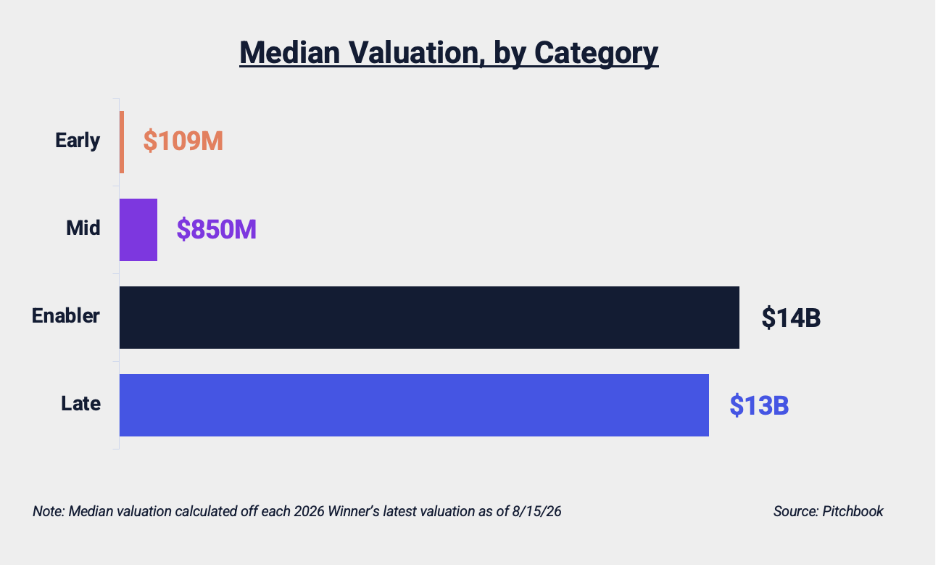
This year’s IA40 companies fall into four categories
- Early – Up to $50M total capital raised
- Mid – $50M – $200M total capital raised
- Late – $200M+ total capital raised
- Enabler – Stage Agnostic (We define enablers as the companies building the tools and infrastructure that enable intelligent applications.)
Funding data categorized as of 8/15/2026
We’re also spotlighting three Emerging Enabler Winners this year, enablers that raised less than $100M and came close enough to the main list to earn a callout of their own.
Key Takeaways From the 2026 IA40
Intelligent, agentic applications built for a single professional workflow are a growing category across this year’s list.
Nearly every category and stage bucket includes at least one company applying AI agents to a specific job to be done and owning a domain, from IT service management with Serval and customer service with Sierra to marketing operations with Gradial, sales with Clay, legal work with Legora, medicine with OpenEvidence, software engineering with Cognition, CodeRabbit, and Zed, CRM with Clarify, quote-to-cash with Roadrunner, and design with Paper. This pattern runs through all five categories, not just a particular stage.
AI trust, governance, and security has become its own category, not just a feature.
JetStream Security, Fable Security, and AI Underwriting Company all exist purely to make enterprises comfortable deploying autonomous AI agents, covering governance and visibility, human risk management, and insurance and certification respectively. That reflects how fast enterprise anxiety about agentic AI is growing, and investors are funding the answer to that sentiment almost as fast as they are funding the agents themselves. These winners exhibit some of the key findings in our own proprietary enterprise survey and report: when buying AI solutions, data security and privacy is the #1 overall purchase criteria; it ranks among the top three for 78% of enterprises.
Frontier labs and hyperscaler-backed infrastructure now operate on a different capital scale than everything else on the list.
OpenAI, Anthropic, and Databricks are absorbing tens of billions of dollars per round, increasingly funded by strategic capital from the likes of Amazon, Google, Nvidia, and SoftBank rather than traditional venture. That scale makes every other category on this list look capital light by comparison, and it lines up with the funding data above, where those three companies alone account for 92% of the capital raised across this year’s and last year’s combined cohort.
Coding continues to be an enormous market and the leading frontier for disruption, with newer players breaking into the list.
Vibe-coding continues to drive significant venture investment: Lovable just announced a $400 million Series C at a $13.3 billion valuation, and Vercel (with their v0 platform) remaining on the list. Add in Cognition (Windsurf), CodeRabbit, and Zed, and it becomes clear that AI-assisted and AI-driven coding is quietly pulling in some of the largest checks on the entire list. A layer beneath the codegen companies, Pierre is also building the infrastructure platform to store code and other artifacts to power agentic workloads as companies all leverage AI to scale.
Voice has matured from a single feature into its own multi-stage platform stack.
Wispr Flow is building the dictation layer, ElevenLabs spans text-to-speech, voice cloning, and agents, and Cartesia is powering real-time speech models under the hood, while HeyGen is doing the same work for video. Together they show voice moving from point products to serious infrastructure, not just a feature bolted onto an app.
Productivity and meeting-capture tools are converging on the same bet, that whoever holds the notes becomes the system of record.
Granola and Fireflies.ai all started as individual productivity tools built around meeting notes and transcription, and each is now explicitly repositioning toward becoming the enterprise knowledge layer for its customers. That wedge-to-platform pattern is showing up independently across companies. This is also apparent in other productivity and research tools such as Wispr Flow and Listen Labs, where they initially owned transcription and proprietary research respectively, but are now scaling into more end-to-end use cases.
Founder pedigree skews heavily toward repeat operators and researchers, across every stage of the list.
Bret Taylor, the former Salesforce co-CEO, and Clay Bavor, a former Google VP, lead Sierra. Palmer Luckey, who founded Oculus, leads Anduril. Qasar Younis, a former YC COO, leads Applied Intuition. Simile was founded out of a cluster of Stanford faculty, and both JetStream Security and Fable Security were built by veterans of category-defining security companies, including CrowdStrike, Attivo, SentinelOne, and Abnormal Security. Both first-time founders and pedigreed are making it on the list, but teams that have established credibility are driving trust with enterprises and momentum with investors.
Thematic Insights: AI Applications
This year’s Early-stage winners skew toward AI-native tools that automate a specific slice of professional judgment or busywork, rather than consumer novelties.
CRM, quote-to-cash, meeting notes, design, code review, and coding environments make up the bulk of this cohort. A second, equally strong cluster is AI-risk infrastructure, where AI Underwriting Company, JetStream Security, and Fable Security, three of the eleven Early winners, exist purely to make enterprises comfortable deploying AI agents, spanning insurance and certification, governance and visibility, and human risk management. Founder pedigree here is heavy with repeat operators from category-defining companies, and several companies launched from stealth with unusually large seed rounds of $15 million to $34 million, sized more like the Series A rounds of a few years ago.
This year’s Mid-stage winners cluster around AI replacing or reinventing white-collar workflows that did not exist as standalone software categories before generative AI.
IT help desks, marketing operations, code review, customer research, and search and marketing visibility are all represented. A second theme is voice and meeting capture as a wedge, with Wispr Flow, Granola, and adjacently HeyGen for video, where individual-productivity products are racing to become enterprise knowledge layers. Fundraising velocity is the standout pattern in this group. Multiple companies closed two or more rounds within a single 12-month window, several crossed $1 billion-plus valuations within 18 to 24 months, and two companies here, Wispr Flow and CodeRabbit, already raised rounds in recent weeks that push their total capital raised past the $200 million Mid ceiling, to $359 million and $223 million respectively, a reminder of how quickly capital can be raised in the current environment.
The Late-stage cohort pairs high-stakes agentic applications with capital-intensive, physical, and frontier AI plays.
Customer service, medicine, law, software engineering, and GTM and sales are all represented by agentic AI applied to high-stakes, high-context professional work, alongside defense, autonomy simulation, and voice on the physical and frontier side. Round cadence in this group has compressed dramatically, with several companies closing two or three nine- to ten-figure rounds within a single 12-month window and valuations often doubling in under six months. Founder pedigree skews toward repeat, operators and researchers rather than first-time founders, and the cohort is notably international, with three Nordic-founded companies, ElevenLabs, Legora, and Lovable, reaching multi-billion-dollar valuations on the strength of their enterprise and U.S. expansion.
Thematic Insights: Enablers
The data layer is a fundamental enabler of AI reasoning and automation, powering the contextual fabric that allows applications to scale from tackling narrow tasks to enterprise-wide decisions.
Databricks making the list a sixth straight year says something about how central the modern data layer has become to the AI stack. Agents can’t reason, adapt, or improve without data that’s reliable, accessible, and constantly refreshed, and Databricks built its lakehouse architecture specifically to give agents that kind of access across structured and unstructured data alike, feeding a flywheel of ongoing ingestion, annotation, and retrieval. More broadly, the Enabler category splits into sub-segments with very different capital intensity. Frontier model labs like Anthropic and OpenAI, plus Databricks, absorb capital at a scale that eclipses the rest of the list, increasingly funded by strategic and hyperscaler money rather than traditional venture. We’d be shocked if Databricks does not land on next year’s list too, assuming it hasn’t gone public by then.
Inference as a service is emerging as its own pattern, and it’s the most crowded, fastest-accelerating sub-segment among Enablers, with no clear winner yet.
Baseten, Together AI, Fireworks, Fal, and OpenRouter are all roughly doubling or more their valuations year over year as demand for GPU capacity and multi-model routing outstrips supply, and although all well-funded there is not yet one clear winner pulling away. The dominance of this Enabler sub-segment is in sharp contrast to the 2025 Enablers list, where there were only two inference play winners (Together and Fal). Data infrastructure shows similar acceleration, though divergence in fundraises. ClickHouse has scaled to mega-rounds and a roughly $15 billion valuation, while Turbopuffer has stayed capital-light despite reportedly hitting around $100 million in annualized revenue, proof that some infrastructure businesses can scale revenue without matching capital intensity.
The Emerging Enablers are the scaffolding of agentic AI, and they are compounding fast.
Gimlet Labs, Browserbase, and Mastra each went from founding or a stealth exit to eight- or nine-figure raises within 12 to 18 months, with Series A landing just four to six months after seed. All three lean on the same dense pocket of YC and founder-network angels, including Guillermo Rauch, Paul Graham, Dylan Field, and Amjad Masad, before larger funds commit at Series A or B. Thematically the group covers compute and inference substrate, web-interaction substrate, and developer-framework substrate, each solving a distinct bottleneck in getting agents from prototype to production. Interestingly, these Emerging Enabler sub-themes diverge from those in this category last year (Modal, Haize Labs, Braintrust, LangChain, Arcee AI), reflecting a decreased emphasis on evals and orchestration frameworks.
Looking Ahead
Next year’s bottleneck won’t be model capability. It will be whether enterprises can turn AI spend into results fast enough to justify the next renewal. They have the appetite: according to our proprietary enterprise survey, 74% plan to expand AI budgets over the next year, and most now treat AI spend as its own line item instead of an experiment. What’s still missing is a reliable path from pilot to production, and landing the deal isn’t the finish line either. 77% of enterprises re-evaluate their AI vendors at least every six months, so the companies that stay on next year’s list will be the ones building continuous proof of value into the product itself, not just into the pitch. Meanwhile, 83% of enterprises already say AI is reshaping their workforce without reducing headcount; we want to continue to watch how this evolves on the human side.
That pressure will keep reshaping the list itself. Sales cycles have already compressed, with 52% of AI deals now closing in under six months, so speed to first contract stops being the differentiator it once was. Discovery is shifting too. 41% of enterprises say they find AI tools through their own engineering teams testing them, not through a sales pitch, so next year’s winners will likely be companies practitioners already trust before procurement ever gets involved.
We still expect the IPO window to open further and hyperscalers to keep competing hard for standout companies and their talent, which should keep turnover elevated, especially among the search-adjacent and agentic commerce infrastructure companies we’re watching closely.
Madrona has spent more than ten years partnering with the founders building intelligent applications and more than 30 years investing in forward-looking companies, backing them as they transform entire industries and push the boundaries of what software can do. This year’s IA40 companies are defining the next chapter of human-technology interaction, and their work deserves to be recognized.
You can read more about the process and methodology here.
The 2026 IA40
Early
- Yutori
- Paper
- AI Underwriting Company
- Pierre
- Clarify
- JetStream Security
- Fable Security
- Resend
- Roadrunner
- Fireflies.ai
- Zed Industries
Mid
- Wispr Flow
- Granola
- Serval
- Profound
- Gamma
- Linear
- CodeRabbit
- Gradial
- Listen Labs
- Town
- HeyGen
Late
- ElevenLabs
- Anduril
- Ramp
- Sierra
- OpenEvidence
- Cognition
- Applied Intuition
- Legora
- Clay
- Lovable
- Simile
Enabler
- Anthropic
- Turbopuffer
- Databricks
- OpenAI
- Baseten
- OpenRouter
- ClickHouse
- Cartesia
- Together AI
- Fal
- Vercel
- Fireworks AI
Emerging Enabler
- Gimlet Labs
- Browserbase
- Mastra
Related Insights